
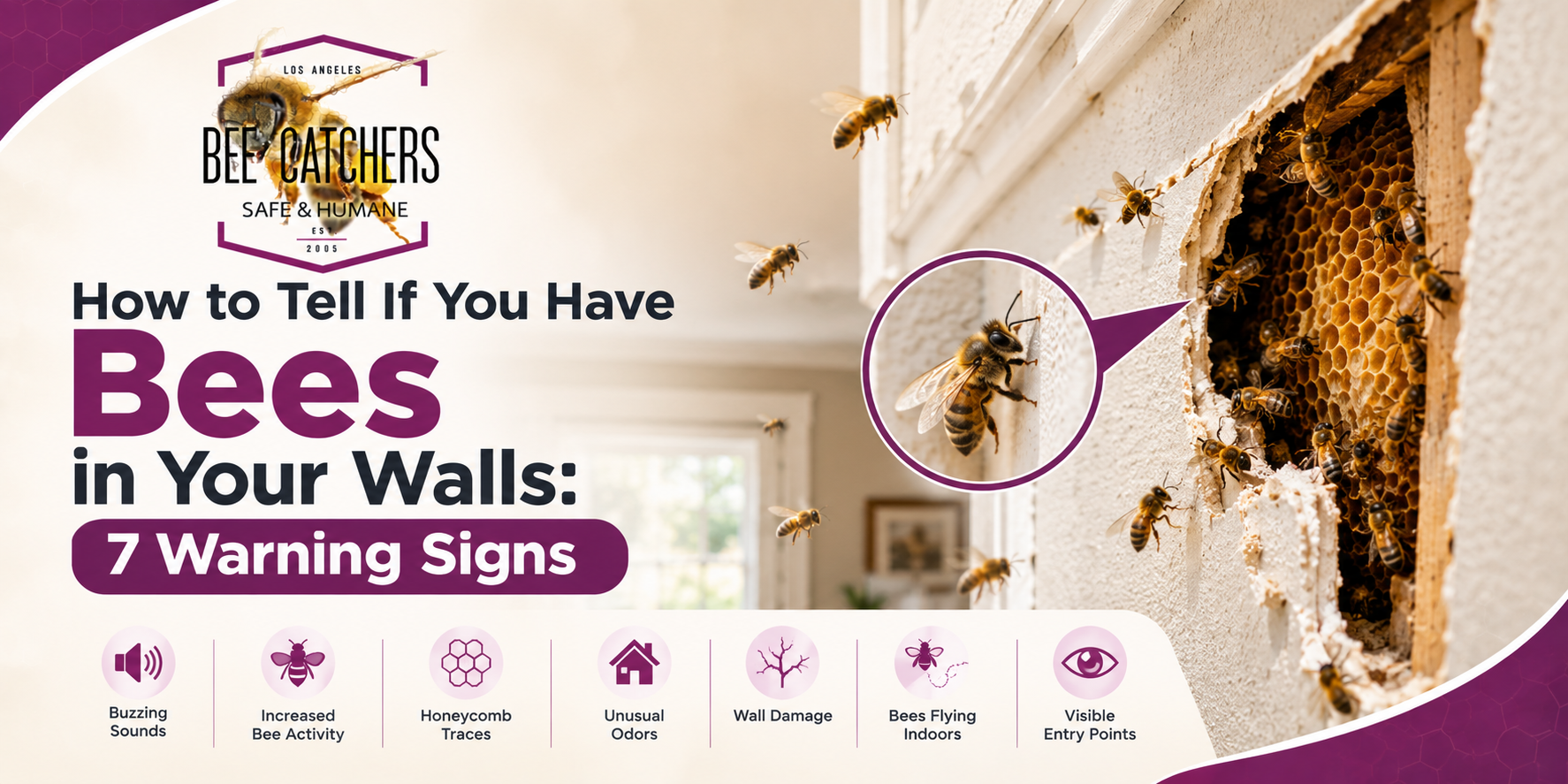
That faint buzzing sound behind your bedroom wall might not be your imagination. Bees are surprisingly good at moving into a house without anyone noticing — until the colony has grown large enough that the signs become impossible to ignore. Here’s how to know for sure before the problem gets bigger (and more expensive) than it needs to be.
1. A Constant Humming or Buzzing Sound
The most common first clue. If you hear a low, steady hum coming from inside a wall, attic, or ceiling — especially one that gets louder on warm, sunny days — there’s a good chance an active colony is behind it. A single stray bee is nothing to worry about; a continuous hum from one fixed spot usually means an established hive.
2. Bees Repeatedly Entering and Exiting the Same Small Gap
Watch the outside of your home for a few minutes. If you see bees flying in and out of the same crack, vent, weep hole, or gap in the siding or eaves — not just landing on flowers nearby — that gap is likely the entrance to a colony living inside your wall cavity.
3. Dark Stains or Discoloration on Drywall or Ceiling
As a colony grows, comb inside the wall can fill with honey. In warm weather, that honey can soften and seep through drywall, leaving yellow-brown stains, bubbling paint, or a slowly spreading dark patch — often mistaken for a water leak.
4. A Sweet, Fermented Smell Indoors
Honey and beeswax have a distinct sweet smell. If a room suddenly has a faint honey-like or slightly fermented odor with no obvious source, it can mean comb has been building up inside the wall for weeks or months.
5. Warm Patches on the Wall
An active hive generates heat — bees regulate hive temperature by fanning their wings. Press a hand against the suspected section of wall on a cool day; a noticeably warmer patch compared to the surrounding wall can be a sign of colony activity inside.
6. Increased Bee Activity Just Outside That Same Spot
If you’ve noticed more bees than usual hovering, landing, or circling near one specific exterior spot — a vent, a gap under the roofline, a hole in the stucco — rather than being spread across your garden, that concentration usually points to a nearby hive entrance.
7. Secondary Pests Showing Up Nearby
Old or leaking honeycomb attracts ants, moths, and even rodents. If you’ve suddenly got an ant trail heading toward one section of wall, or notice small moths near a vent, it can be a secondary sign that comb (active or abandoned) is present inside.
What to Do If You Notice 2 or More of These Signs
One sign alone might be nothing. But if you’re noticing two or more — say, a humming sound and a warm patch, or a stain and bees entering the same gap — it’s time to call a professional rather than wait it out.
Do not seal the entrance or spray pesticide yourself. Sealing bees inside without removing the comb traps a colony that will die and rot inside your wall, and pesticide alone won’t stop honey from melting and leaking through your drywall later. A licensed bee removal specialist can inspect the wall, confirm the colony’s location, and safely remove both the bees and the comb — then repair the structure properly.
Think You Have Bees in Your Walls? Let’s Find Out.
Bee Catchers, Inc. has been inspecting and safely removing bee colonies from walls, roofs, and structures across Los Angeles, Orange, Ventura, and Riverside Counties for over five decades. Our technicians are licensed, our comb removal is thorough, and our structural repairs are handled in-house — so the problem doesn’t come back.
Notice any of these signs? Call 866.544.0074 or 818.448.2149 for a fast inspection — 7 days a week.
Recent Comments