ALIVE IN THE HIVE

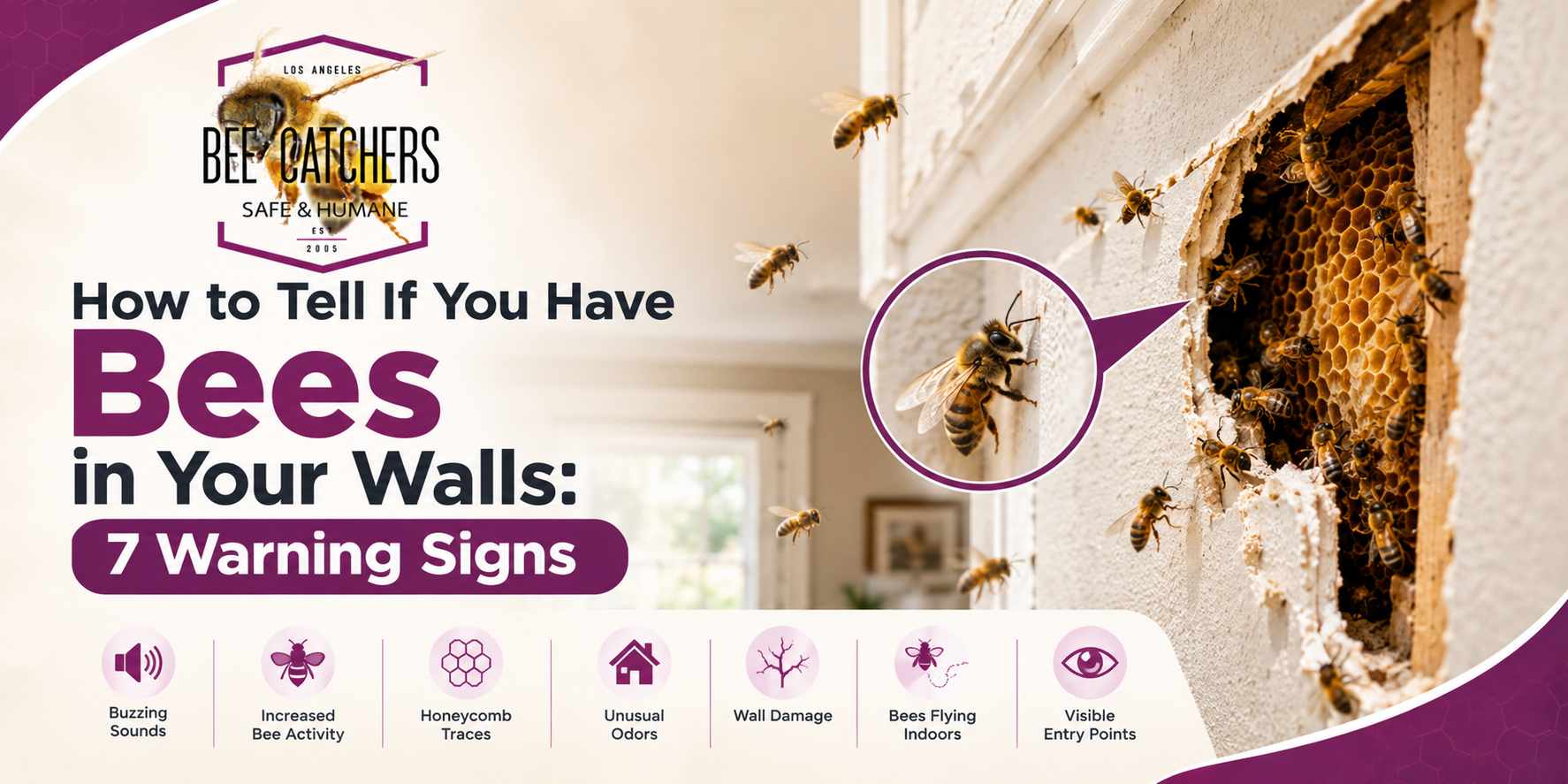
How to Tell If You Have Bees in Your Walls: 7 Warning Signs

That faint buzzing sound behind your bedroom wall might not be your imagination. Bees are surprisingly good at moving into a house without anyone noticing — until the colony has grown large enough that the signs become impossible to ignore. Here’s how to know for sure before the problem gets bigger (and more expensive) than it needs to be.

1. A Constant Humming or Buzzing Sound

The most common first clue. If you hear a low, steady hum coming from inside a wall, attic, or ceiling — especially one that gets louder on warm, sunny days — there’s a good chance an active colony is behind it. A single stray bee is nothing to worry about; a continuous hum from one fixed spot usually means an established hive.

2. Bees Repeatedly Entering and Exiting the Same Small Gap

Watch the outside of your home for a few minutes. If you see bees flying in and out of the same crack, vent, weep hole, or gap in the siding or eaves — not just landing on flowers nearby — that gap is likely the entrance to a colony living inside your wall cavity.

3. Dark Stains or Discoloration on Drywall or Ceiling

As a colony grows, comb inside the wall can fill with honey. In warm weather, that honey can soften and seep through drywall, leaving yellow-brown stains, bubbling paint, or a slowly spreading dark patch — often mistaken for a water leak.

4. A Sweet, Fermented Smell Indoors

Honey and beeswax have a distinct sweet smell. If a room suddenly has a faint honey-like or slightly fermented odor with no obvious source, it can mean comb has been building up inside the wall for weeks or months.

5. Warm Patches on the Wall

An active hive generates heat — bees regulate hive temperature by fanning their wings. Press a hand against the suspected section of wall on a cool day; a noticeably warmer patch compared to the surrounding wall can be a sign of colony activity inside.

6. Increased Bee Activity Just Outside That Same Spot

If you’ve noticed more bees than usual hovering, landing, or circling near one specific exterior spot — a vent, a gap under the roofline, a hole in the stucco — rather than being spread across your garden, that concentration usually points to a nearby hive entrance.

7. Secondary Pests Showing Up Nearby

Old or leaking honeycomb attracts ants, moths, and even rodents. If you’ve suddenly got an ant trail heading toward one section of wall, or notice small moths near a vent, it can be a secondary sign that comb (active or abandoned) is present inside.

What to Do If You Notice 2 or More of These Signs

One sign alone might be nothing. But if you’re noticing two or more — say, a humming sound and a warm patch, or a stain and bees entering the same gap — it’s time to call a professional rather than wait it out.

Do not seal the entrance or spray pesticide yourself. Sealing bees inside without removing the comb traps a colony that will die and rot inside your wall, and pesticide alone won’t stop honey from melting and leaking through your drywall later. A licensed bee removal specialist can inspect the wall, confirm the colony’s location, and safely remove both the bees and the comb — then repair the structure properly.

Think You Have Bees in Your Walls? Let’s Find Out.

Bee Catchers, Inc. has been inspecting and safely removing bee colonies from walls, roofs, and structures across Los Angeles, Orange, Ventura, and Riverside Counties for over five decades. Our technicians are licensed, our comb removal is thorough, and our structural repairs are handled in-house — so the problem doesn’t come back.

Notice any of these signs? Call 866.544.0074 or 818.448.2149 for a fast inspection — 7 days a week.

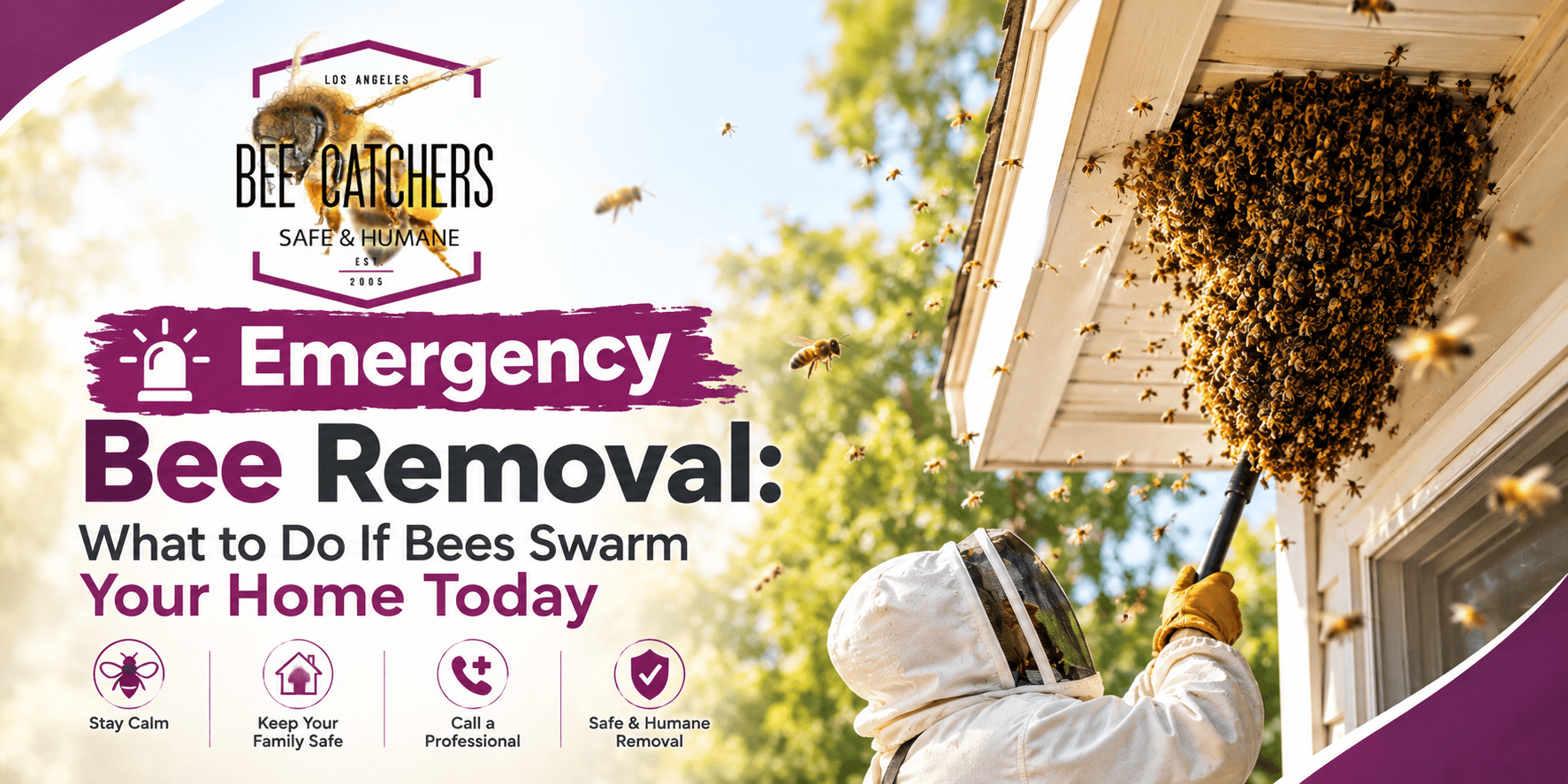
Emergency Bee Removal: What to Do If Bees Swarm Your Home Today

A bee swarm can show up without warning — one afternoon your yard is quiet, and the next there’s a buzzing cloud of thousands of bees clustered on a tree branch, fence post, or even the side of your house. If this is happening to you right now, here’s exactly what to do.

Step 1: Stay Calm and Keep Distance

A swarm in the open (not yet settled into a wall or cavity) is usually not aggressive — bees in a swarm have no hive to defend yet. Still, keep children, pets, and neighbors at least 20 feet away, and don’t throw anything at it, spray it with water, or disturb it.

Step 2: Do NOT Spray Pesticide or Try DIY Removal

This is the single biggest mistake homeowners make. Spraying a swarm or an established colony:

  • Agitates the bees and dramatically increases sting risk
  • Doesn’t kill the queen or the comb inside walls, so the problem returns
  • Can drive bees deeper into a wall cavity, making professional removal harder and more expensive later
  • Kills a pollinator species that’s already in serious decline

Step 3: Identify — Is It a Swarm or an Established Hive?

  • Swarm: A tight, football-shaped cluster of bees hanging in the open, usually temporary (a few hours to a couple of days) while scout bees look for a permanent home. Often easier and cheaper to relocate.
  • Established colony: Bees flying in and out of a specific gap — a wall vent, roofline, water meter box, or hole in stucco — means they’ve already built comb inside. This requires full extraction, not just a scoop-and-go.

Step 4: Call a Licensed Live Bee Removal Company — Not a General Exterminator

General pest control companies are trained to kill, not relocate. A licensed bee removal specialist will:

  • Assess whether it’s a swarm or established colony
  • Safely remove bees and the honeycomb, if present
  • Relocate the colony alive to a beekeeper, farm, or sanctuary
  • Repair any structural opening the bees used to get in

Step 5: Same-Day Service Is Available

Swarms can relocate on their own within 24–48 hours if left alone, but if the swarm has settled somewhere unsafe (near a doorway, playground, or high-traffic area), same-day professional removal is the safest option — for the bees and for your family.

We Respond Fast, 7 Days a Week

Bee Catchers, Inc. has been Southern California’s trusted live bee removal service for over five decades. Our licensed, uniformed technicians respond quickly across Los Angeles, Orange, Ventura, and Riverside Counties, using safe, hands-on methods — never extermination.

Bees swarming right now? Call 866.544.0074 or 818.448.2149 for immediate assistance.

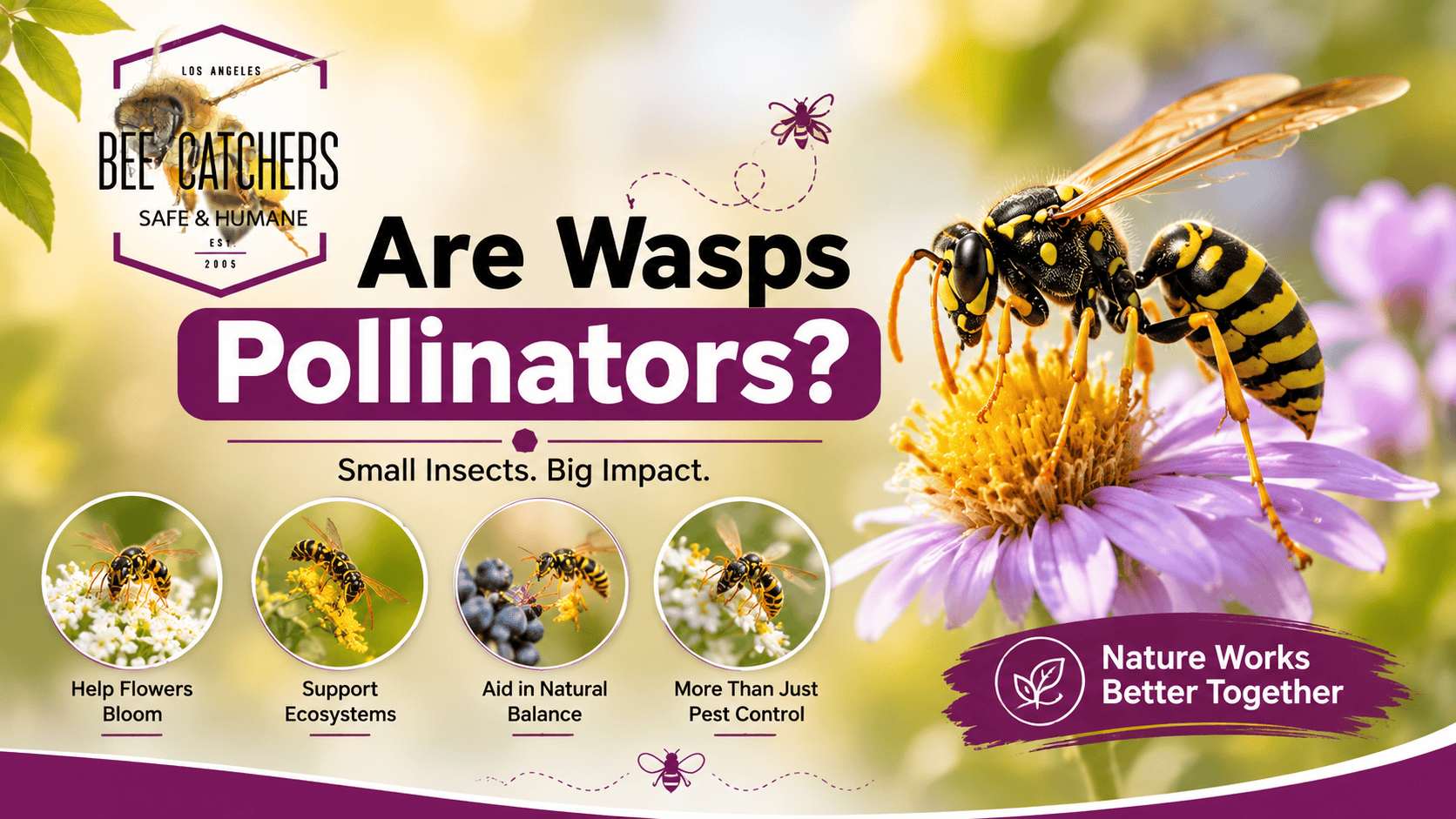
Are Wasps Pollinators? What Southern California Homeowners Need to Know

If you’ve ever watched a black-and-yellow insect hover near your patio flowers and wondered whether it was helping your garden or just crashing your backyard barbecue, you’re not alone. It’s one of the most common questions the team at Bee Catchers, Inc hears from homeowners across Southern California: are wasps pollinators, or are they simply pests that look like bees?

The honest answer is a little more nuanced than a flat “yes” or “no.” Wasps can move pollen from flower to flower, but they aren’t built for the job the way honeybees are, and their role in your garden is very different from the role a bee colony plays. Understanding that difference matters, because it changes how you should react when you spot a nest on your property.

At Bee Catchers, Inc, we’ve spent decades removing and relocating stinging insects across the greater Los Angeles area, and one thing we see constantly is confusion between wasps and bees. That confusion often leads to the wrong call — literally. People spray a beneficial honeybee colony with pesticide, or they try to knock down an aggressive wasp nest themselves and end up with multiple stings. This guide is here to clear things up once and for all.

So, Are Wasps Pollinators?

Technically, yes — wasps are considered incidental pollinators. As they move from flower to flower feeding on nectar, tiny amounts of pollen stick to their bodies and get transferred along the way. Some wasp species, like fig wasps, even have a highly specialized pollination relationship with specific plants that couldn’t reproduce without them.

However, wasps are nowhere near as effective as bees when it comes to pollination, and here’s why:

  • Wasps have smooth, mostly hairless bodies. Bees are covered in branched, fuzzy hairs specifically designed to trap and carry pollen grains. Wasps lack this feature almost entirely, so far less pollen sticks to them.
  • Wasps aren’t dedicated flower feeders. Most wasps are predatory or scavenging insects. They visit flowers occasionally for a nectar snack, but they spend much of their time hunting other insects, scavenging meat, or foraging around trash cans — not systematically working through a garden bed the way a honeybee does.
  • Wasps don’t have pollen-carrying structures. Bees have specialized pollen baskets (corbiculae) on their hind legs to intentionally collect and transport pollen back to the hive. Wasps have no such structure because pollen collection isn’t part of their biological purpose.

So while it’s fair to say wasps play a minor, incidental role in pollination, they are not considered reliable or essential pollinators the way honeybees are. If wasps disappeared tomorrow, most food crops would be just fine. If honeybees disappeared, global agriculture would be in serious trouble — a distinction the team at Bee Catchers, Inc takes seriously in everything we do.

Wasps vs Bees: Breaking Down the Real Differences

The wasps vs bees debate comes up constantly, and it’s easy to see why — both insects are yellow and black, both can sting, and both show up around the same flowers and picnic tables. But once you know what to look for, telling them apart becomes second nature.

Body Shape and Appearance

  • Bees are round, plump, and fuzzy. Their bodies are built to hold pollen, and you can often see pollen sacs on their hind legs.
  • Wasps have slender, smooth, almost polished-looking bodies with a distinct narrow “waist” separating the thorax from the abdomen.

Behavior

  • Bees are generally calm and focused on flowers. A honeybee that stings usually dies afterward, since its barbed stinger stays lodged in the skin — which means bees typically avoid stinging unless truly threatened.
  • Wasps are more aggressive, especially in late summer and early fall when natural food sources dry up and they start scavenging around homes for sugar and protein. Unlike bees, wasps can sting repeatedly without dying.

Diet

  • Bees feed almost exclusively on nectar and pollen.
  • Wasps are largely predatory or scavenging, feeding on other insects, spiders, and scraps of human food — which is part of why they’re actually helpful for natural pest control in gardens, even if they aren’t great pollinators.

Nesting Habits

  • Bees build wax comb hives in tree hollows, wall cavities, chimneys, or man-made boxes.
  • Wasps build nests from a papery material they create by chewing wood fibers, often underground, in wall voids, under eaves, or hanging from tree branches.

If you’re staring at an insect and trying to figure out which category it falls into, our team at Bee Catchers, Inc has already broken this down in detail in our guide on bees vs. yellow jackets, which covers one of the most commonly confused wasp species side by side with honeybees.

What Does a Common Wasp Nest Look Like?

Recognizing a common wasp nest is one of the fastest ways to protect yourself and your family from an unpleasant surprise. Unlike a honeybee hive, which is made of golden wax comb, wasp nests are constructed from a gray, papery material that resembles thin cardboard. Wasps create this material by chewing up wood fibers and mixing them with their saliva.

Common wasp nest locations include:

  • Underground burrows, often repurposed from abandoned rodent holes
  • Inside wall voids or attic spaces, where the nest can grow undetected until it’s quite large
  • Under roof eaves, deck overhangs, or porch ceilings
  • Hanging from tree branches or shrubs, shaped like an upside-down teardrop or football
  • Inside sheds, garages, or unused outdoor furniture

A mature wasp nest can house hundreds of wasps by late summer, which is exactly why nests tend to seem to “appear out of nowhere” — they start small in spring and grow rapidly through the warmer months. If you spot papery layers rather than wax comb, you’re very likely dealing with a wasp colony rather than a beehive, and the removal approach should be different.

For homeowners who are still unsure what they’re looking at, browsing real examples in our photo gallery can help you compare what you’ve found on your property against confirmed nest photos before deciding on next steps.

Black Wasp with White Stripes: What Species Is It?

One of the more frequently searched identification questions we get is about a black wasp with white stripes. This description most commonly points to one of a few species found throughout California:

  • Bald-faced hornets — despite the name, these are actually a type of wasp, not a true hornet. They have a mostly black body with distinctive white or ivory markings on the face and the tip of the abdomen. They build large, enclosed, gray paper nests, often high in trees or attached to the sides of buildings.
  • White-banded wasps and certain thread-waisted wasp species also display bold black-and-white coloring rather than the more familiar yellow-and-black pattern.
  • Some spider wasps and mud dauber species can also appear predominantly dark with pale banding, depending on the species and region.

Black-and-white patterned wasps tend to be just as capable of stinging as their yellow-and-black cousins, and bald-faced hornets in particular are known for being highly defensive around their nests. If you’ve spotted one of these insects repeatedly around your property, it’s worth having a professional confirm the species before deciding how to handle it — misidentifying an aggressive nest-builder as a harmless insect is a common (and painful) mistake.

What Does a Wasp Look Like, Exactly?

For homeowners trying to answer the basic question of what does a wasp look like, here’s a quick physical rundown that applies to most common species:

  • Narrow, defined waist connecting the thorax and abdomen — this is one of the clearest giveaways
  • Smooth, shiny exoskeleton with little to no visible body hair
  • Long, slender legs that often dangle visibly during flight
  • Two pairs of wings, which fold neatly along the body at rest
  • Coloring that varies by species — most people picture the classic yellow-and-black pattern, but as covered above, some wasps are black with white or pale markings instead

Behaviorally, wasps also tend to fly in a faster, more erratic, darting pattern compared to the slower, more deliberate flight of a foraging bee. If you see an insect zig-zagging aggressively around your trash cans or soda cans at a backyard gathering, that erratic flight pattern alone is often a strong clue you’re dealing with a wasp rather than a bee.

Wasps and Bees in Photos: Side-by-Side Comparison

Because written descriptions only go so far, many homeowners searching for photos of bees and wasps are really trying to do a visual double-check before deciding how to respond to an insect on their property. When comparing photos side by side, focus on these details:

  1. Body texture — fuzzy and round (bee) vs. smooth and slender (wasp)
  2. Waist definition — barely visible (bee) vs. sharply pinched (wasp)
  3. Leg appearance — often carrying visible pollen (bee) vs. bare, dangling legs (wasp)
  4. Nest material visible in the background — golden wax comb (bee) vs. gray papery material (wasp)

The Bee Catchers, Inc team regularly documents real hives and nests we’ve encountered across Los Angeles, Orange, Ventura, and Riverside Counties, and our photo gallery is a great free resource if you want to compare your own backyard sighting against confirmed images before making a decision.

What Is a Bumblebee Wasp?

Another search that trips people up is the term bumblebee wasp. This isn’t an official scientific classification — it’s a common nickname people use for a couple of different things:

  • Wasps that mimic bumblebees in coloring and body shape as a survival strategy, since predators tend to avoid the more heavily defended bumblebee. This is a form of Batesian mimicry, where a harmless or less-defended species evolves to resemble a more dangerous one.
  • Certain velvet ant species (which are technically wingless wasps, not ants) are sometimes described this way due to their fuzzy, rounded appearance combined with wasp-like stinging capability.
  • Some people also use the term loosely to describe large, robust wasp species that are chunkier than the typical slender wasp body type, giving them a bumblebee-like silhouette at a glance.

The key takeaway is that a “bumblebee wasp” is generally a wasp species that has evolved to look like a bumblebee for protective purposes, not an actual hybrid or bee species. If you’re unsure whether something buzzing around your yard is a true bumblebee or a bumblebee-mimicking wasp, closer inspection of the waist (bumblebees don’t have a pinched waist; wasps do) is usually the fastest way to tell.

Why This Distinction Matters for Removal Decisions

This isn’t just a fun biology lesson — correctly identifying what’s on your property has real consequences. Because honeybees are essential pollinators responsible for a huge share of the food we eat, Bee Catchers, Inc specializes in humane, live removal and relocation rather than extermination. Every colony we remove is relocated through our nonprofit partner, the BeeQuilibrium Foundation, so the bees can continue their critical pollination work at farms, orchards, and apiaries.

Wasps, on the other hand, are typically not relocated as a colony. Since they aren’t essential pollinators and can pose a higher risk to people and pets — especially aggressive species like yellow jackets and bald-faced hornets — nests are usually addressed as a pest control matter rather than a conservation effort.

That’s exactly why getting the identification right matters before anyone reaches for a spray can or calls the wrong kind of service. Treating a beneficial honeybee hive like a pest problem can result in the unnecessary loss of a pollinator colony, while underestimating an aggressive wasp nest can lead to painful, repeated stings.

What to Do If You Find a Nest on Your Property

If you’ve discovered a nest and you’re not sure whether you’re dealing with bees or wasps, here’s the safest path forward:

  1. Keep your distance. Don’t spray, poke, or disturb the nest while you’re still trying to identify it.
  2. Observe from a safe spot. Note the nest material (wax vs. paper), its location, and the insects’ flight pattern.
  3. Take a photo if it’s safe to do so. A clear picture helps a professional identify the species remotely before a visit.
  4. Call a licensed professional. Our team at Bee Catchers, Inc can quickly tell you what you’re dealing with, whether it’s a honeybee colony that needs humane relocation or a wasp nest that calls for a different approach.
  5. Skip the DIY sprays. Store-bought insecticides are often ineffective against an established nest and can trigger a defensive swarm response.

You can check our full range of bee removal services or see if we cover your area on our locations page. If you’d rather just get someone on the phone, our contact page has everything you need to reach our licensed, uniformed technicians directly.

Final Thoughts

So, are wasps pollinators? In a limited, incidental sense — yes, but they’re nowhere near as important to our food supply as honeybees. Wasps play their own valuable role in nature by controlling other insect populations, but when it comes to pollinating the flowers, fruits, and vegetables we depend on, that job belongs almost entirely to bees.

Whether you’re trying to identify a common wasp nest, figure out what a black wasp with white stripes actually is, or simply settle the wasps vs bees debate once and for all, knowing the difference protects both your family and the pollinators our ecosystem relies on. And whenever you’re unsure, the team at Bee Catchers, Inc is just a phone call away, ready to correctly identify what’s on your property and recommend the safest way to handle it.

Frequently Asked Questions

Q1: Are wasps considered pollinators?

Wasps can transfer small amounts of pollen while feeding on nectar, so they’re considered incidental pollinators. However, their smooth bodies and lack of pollen-carrying structures make them far less effective than bees, which are specially adapted for the job.

Q2: What’s the main difference between wasps and bees?

Bees are fuzzy, round, and focused on collecting pollen and nectar, while wasps have slender, smooth bodies with a narrow waist and are largely predatory or scavenging insects. Behaviorally, bees are generally calmer, while wasps tend to be more aggressive.

Q3: What does a common wasp nest look like?

A typical wasp nest is made of a gray, papery material created from chewed wood fibers, often shaped like an upside-down teardrop. Nests can be found underground, in wall voids, under eaves, or hanging from trees.

Q4: What kind of wasp is black with white stripes?

A black wasp with white markings is often a bald-faced hornet, which despite its name is actually a wasp species. It has a black body with white facial and abdominal markings and builds large, enclosed paper nests.

Q5: What does a wasp look like compared to a bee?

Wasps have smooth, shiny bodies, a distinctly narrow waist, and long dangling legs, while bees appear fuzzy and rounder with visible pollen sacs on their legs. Wasps also tend to fly in a faster, more erratic pattern.

Q6: Is a bumblebee wasp a real species?

“Bumblebee wasp” isn’t an official scientific term — it usually refers to a wasp species that mimics a bumblebee’s coloring and shape for protection, or occasionally to fuzzy, wingless wasps like velvet ants.

Q7: Should a wasp nest be relocated like a beehive?

Generally, no. Because wasps aren’t essential pollinators and can pose a higher safety risk, their nests are usually treated as a pest control issue rather than relocated as a live colony, unlike honeybee hives.

Q8: How can I tell if it’s a bee or wasp nest without getting close?

Look at the material: honeybee hives show golden wax comb, while wasp nests appear as gray, papery layers. You can also observe flight pattern from a distance — bees are slower and more deliberate, wasps are faster and more erratic.

Q9: Why do wasps show up around food and trash more than bees?

Wasps are scavengers as well as predators, so they’re drawn to sugary drinks, meat, and garbage, especially in late summer when natural food sources become scarce. Bees are primarily interested in flowers and nectar.

Q10: Who should I call if I find a nest and I’m not sure what it is?

Contact a licensed professional like Bee Catchers, Inc for identification and safe removal. Our team can determine whether you’re dealing with a honeybee colony that qualifies for humane relocation or a wasp nest that needs a different removal approach.


Not sure whether you’re dealing with bees or wasps? Contact the licensed team at Bee Catchers, Inc for a fast, professional identification and safe removal — protecting both your family and the pollinators our ecosystem depends on.
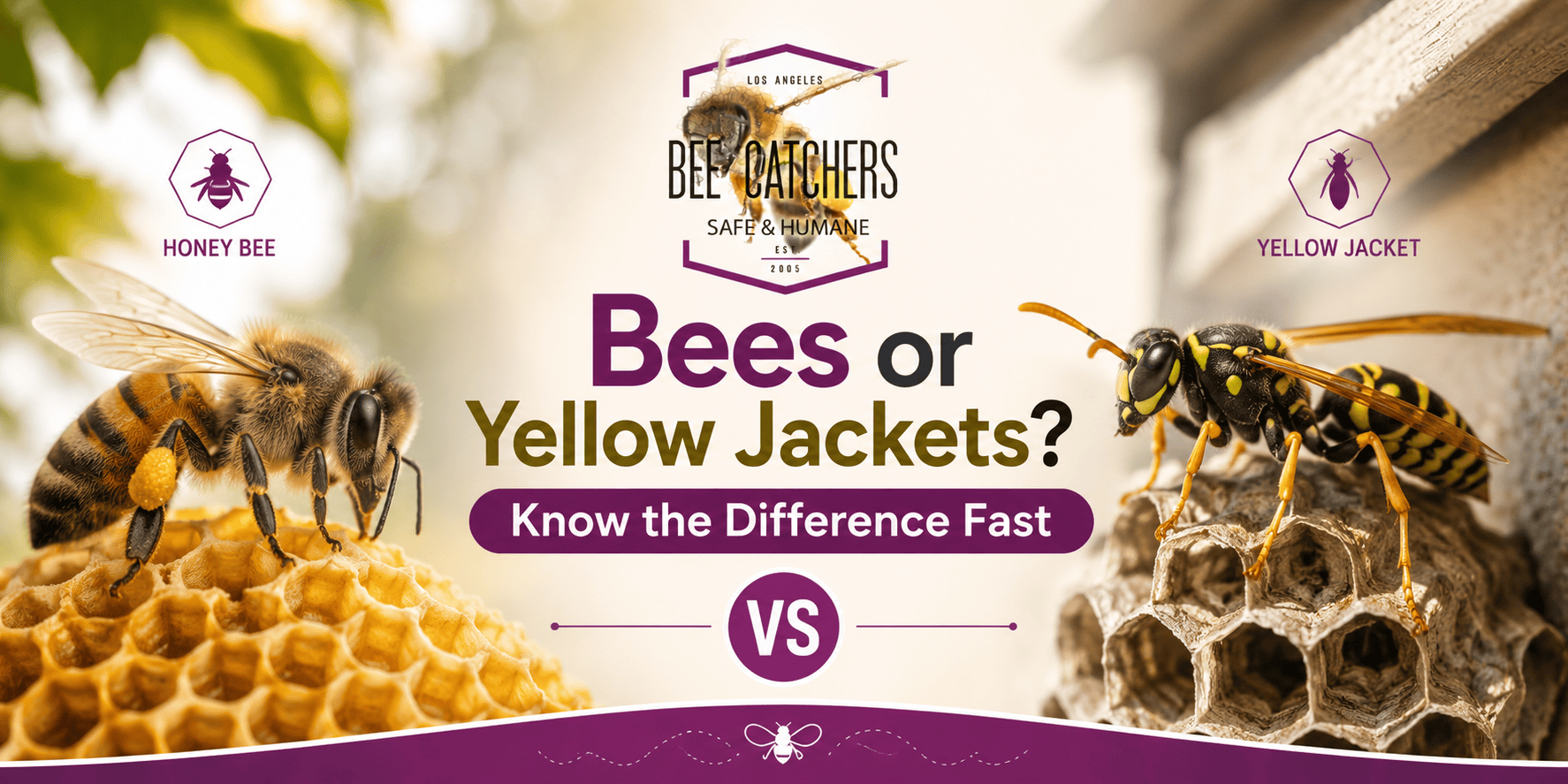
Bees or Yellow Jackets? Know the Difference Fast

If you spot a stinging insect buzzing around your yard, patio, or trash can, your first instinct might be to assume it’s “just a bee.” But not every black-and-yellow flying insect is a honeybee — and mistaking one for the other can lead to the wrong reaction, the wrong home remedy, or worse, unnecessary property damage. Understanding the difference in the bee versus yellow jacket debate isn’t just trivia — it directly affects how you should respond if you find a nest, and whether the situation calls for humane relocation or professional pest management.

This guide breaks down exactly how to tell them apart quickly, why it matters, and what to do if you’ve found a colony on your property.

Why People Confuse Bees and Yellow Jackets

At a glance, both insects share a similar yellow-and-black color pattern and a similar size, which is why so many homeowners search for honey bee vs yellow jacket comparisons after spotting an insect near their home. But biologically, they’re quite different. Honeybees are gentle pollinators that build wax comb structures, while yellow jackets are aggressive wasps that build paper-like nests and are far more likely to sting without much provocation.

Getting the identification wrong matters because the response is completely different: a honeybee colony should be relocated by a licensed bee removal specialist, while a yellow jacket nest is typically better handled through pest control methods, since yellow jackets are not pollinators in the same critical way honeybees are and cannot usually be safely relocated as a live colony.

Bees vs. Yellow Jackets: Physical Appearance

FeatureHoneybeeYellow Jacket
Body shapeRound, fuzzy, robustSlim, smooth, narrow waist
ColorGolden-brown and black, fuzzy stripesBright yellow and black, glossy
HairCovered in fine hair (helps pollen stick)Little to no hair
LegsOften carry visible pollen sacsNo pollen sacs
Flight patternSlower, more deliberateFast, erratic, darting

When people ask, “are yellow jackets bees,” the short answer is no — yellow jackets are actually a type of wasp, not a bee species at all, despite the visual similarity that causes confusion.

Behavioral Differences

This is where the yellow jacket versus honey bee comparison becomes most important for homeowners:

Honeybees

  • Generally calm and non-aggressive unless the hive is directly disturbed
  • Sting only once (they die afterward), so they’re less likely to attack repeatedly
  • Focused on collecting nectar and pollen from flowers
  • Build hives in wall cavities, trees, chimneys, or man-made boxes

Yellow Jackets

  • Aggressive, especially in late summer and fall when food sources become scarce
  • Can sting multiple times without dying
  • Attracted to sugary drinks, meat, and garbage — often seen around picnics, trash cans, and outdoor dining areas
  • Build nests underground, in wall voids, or in attics, often out of a papery material made from chewed wood fibers

If you’ve noticed a yellow jacket and bee both hovering near a structure but behaving very differently — one calmly working flowers, the other aggressively swarming near food — that behavioral gap is one of the clearest ways to tell them apart without getting close enough to risk a sting.

Nest Differences

Nest structure is one of the most reliable ways to identify which insect you’re dealing with:

  • Honeybee hives are made of wax and consist of visible hexagonal comb, often found inside wall cavities, tree hollows, or chimneys. The comb may be visible if the hive is exposed.
  • Yellow jacket nests are made of a paper-like material and are often built underground in abandoned rodent burrows, inside wall voids, or hanging from eaves and attics. They typically have a single visible entrance hole.

If you’re staring at gray, papery layers rather than golden wax comb, you’re very likely looking at a wasp nest rather than a beehive.

Why the Difference Matters for Removal

This is the most practical reason to correctly identify what you’re dealing with. In the honey bees vs yellow jackets comparison, the recommended course of action is completely different:

  • Honeybees are protected pollinators. A licensed, humane bee removal specialist can safely extract and relocate the colony rather than exterminating it, which supports local ecosystems and food production.
  • Yellow jackets are not typically relocated as a colony and are usually treated as a pest control issue, since their aggressive behavior poses a higher risk to people and pets, especially near homes, schools, and outdoor gathering spaces.

Misidentifying a honeybee hive as a yellow jacket nest (or vice versa) can lead to unnecessary use of pesticides on a beneficial pollinator species, or an underestimation of the danger posed by an aggressive wasp colony.

What to Do If You Find a Nest

  1. Keep your distance. Don’t approach, spray, or disturb the nest before identifying it.
  2. Observe from a safe distance. Note the shape of the nest, the insects’ behavior, and their flight pattern.
  3. Take a photo if possible from a safe distance to help a professional identify the species before arriving.
  4. Call a professional. A trained technician can confirm whether you’re dealing with bees or yellow jackets and recommend the safest removal method. Our team handles live bee removal and relocation across the region and can quickly tell you what you’re dealing with over the phone or during an inspection.
  5. Avoid DIY sprays, especially store-bought insecticides, which are often ineffective against a fully established nest and can provoke a swarm response.

If you’re unsure which insect you’re dealing with, browse our photo gallery for real examples of hives and nests we’ve encountered, or check our service locations to see if we cover your area.

Quick Identification Checklist

Ask yourself these questions when trying to identify a stinging insect:

  • Is it fuzzy or smooth? Fuzzy = honeybee. Smooth and shiny = yellow jacket.
  • Is it near flowers or near food/trash? Flowers = honeybee. Food, soda cans, or garbage = yellow jacket.
  • Is the nest made of wax or paper? Wax comb = honeybee. Papery, gray material = yellow jacket.
  • Is it calm or aggressive? Calm and focused = honeybee. Erratic and defensive = yellow jacket.
  • Where is the nest located? Wall cavities, trees, chimneys = often bees. Underground holes, eaves, attics = often yellow jackets.

Final Thoughts

While a yellowjacket vs honey bee mix-up is an easy mistake to make from a distance, taking a moment to observe body shape, behavior, and nest material can help you respond safely and appropriately. Honeybees deserve protection and relocation given their essential role in pollination, while yellow jackets require a different, more pest-control-focused approach due to their aggressive nature. Either way, the safest first step is always the same: keep your distance and call a professional who can correctly identify the species and handle removal safely.


Frequently Asked Questions (FAQs)

Q1: What is the easiest way to tell a bee from a yellow jacket? Look at the body: honeybees are fuzzy, golden-brown, and rounder, while yellow jackets are smooth, shiny, bright yellow, and have a narrow waist. Behavior is another clue — bees are calmer, while yellow jackets are more aggressive and erratic.

Q2: Are yellow jackets a type of bee? No. Despite the similar coloring, yellow jackets are a type of wasp, not a bee species. They belong to a completely different insect family and behave very differently from honeybees.

Q3: Which is more dangerous, a bee or a yellow jacket? Yellow jackets are generally considered more dangerous because they can sting multiple times and are more aggressive, especially in late summer and fall. Honeybees typically only sting once and are less likely to attack unprovoked.

Q4: How can I tell the difference between a beehive and a yellow jacket nest? Beehives are made of wax and form visible hexagonal comb, often found in wall cavities or trees. Yellow jacket nests are made of a papery material and are commonly found underground, in wall voids, or hanging from eaves.

Q5: Why are yellow jackets attracted to my backyard but not bees? Yellow jackets are drawn to sugary drinks, meat, and garbage, making backyards with food, trash cans, or outdoor dining areas more attractive to them. Honeybees are primarily interested in flowers and nectar sources.

Q6: Should I remove a yellow jacket nest myself? It’s not recommended. Yellow jackets are aggressive and can sting repeatedly, making DIY removal risky. A pest control professional is better equipped to handle an active nest safely.

Q7: Can a yellow jacket nest be relocated like a beehive? Generally, no. Unlike honeybee colonies, which are frequently relocated by professionals due to their pollinator status, yellow jacket nests are usually treated as a pest issue rather than relocated as a live colony.

Q8: Do honeybees and yellow jackets build nests in the same places? Sometimes, but there are common patterns: honeybees often nest in wall cavities, chimneys, and trees, while yellow jackets frequently nest underground or in attic spaces and eaves.

Q9: How many times can a yellow jacket sting compared to a bee? Yellow jackets can sting multiple times because their stinger doesn’t detach. Honeybees typically sting only once, since their stinger and venom sac remain in the skin, ultimately killing the bee.

Q10: What should I do if I’m not sure whether it’s a bee or a yellow jacket nest? Keep a safe distance, avoid spraying or disturbing it, and contact a professional for identification and safe removal. A trained technician can quickly confirm the species and recommend the right next step.


Not sure what’s nesting on your property? Contact our licensed team for a fast, professional identification and safe removal — whether it’s honeybees or another stinging insect.

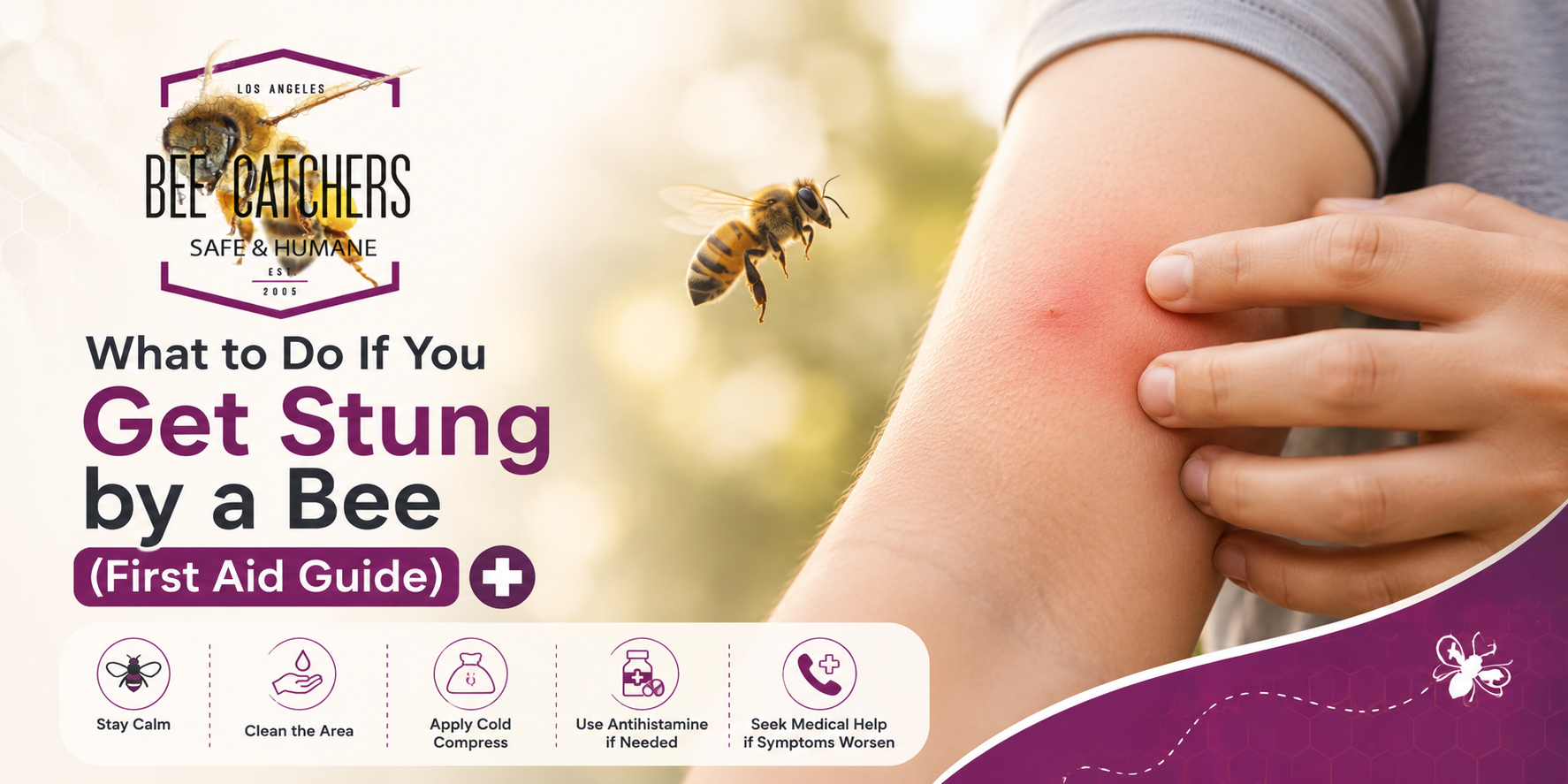
What to Do If You Get Stung by a Bee (First Aid Guide)

Getting stung by a bee is one of those things almost everyone experiences at some point — usually while gardening, walking barefoot on grass, or accidentally disturbing a hive. For most people, a bee sting is painful but harmless. For others, especially those with allergies, it can quickly become a medical emergency. Knowing exactly what to do in the first few minutes after a sting can make all the difference.

This guide walks through immediate first aid steps, warning signs of a serious reaction, and how to protect your home from future encounters with the help of a professional bee removal team.

Why Bee Stings Happen

Bees don’t sting out of aggression for no reason — they sting to defend their colony or in response to being stepped on, swatted, or trapped against skin or clothing. Honeybees can only sting once (their stinger detaches, ultimately killing the bee), while other stinging insects like wasps can sting multiple times. If you’re getting stung repeatedly or multiple people are being stung at once, it likely means an established hive or nest is nearby and has been disturbed — a sign it’s time to call a licensed team for safe, humane hive removal rather than attempting to handle it yourself.

Immediate First Aid Steps for a Bee Sting

Step 1: Move Away From the Area

The first and most important step is to calmly move away from where you were stung. Bees release an alarm pheromone at the sting site that can attract more bees from the same colony. Walk—don’t run—to a safe, enclosed space like indoors or inside a vehicle.

Step 2: Remove the Stinger Quickly

If the stinger is still in your skin, remove it as soon as possible using a fingernail, credit card edge, or tweezers. Speed matters more than method — the stinger continues releasing venom into the skin for several seconds after the sting occurs, so don’t waste time trying to find the “perfect” tool.

Step 3: Wash the Area

Clean the sting site gently with soap and water to reduce the risk of infection.

Step 4: Apply a Cold Compress

Use an ice pack or a cloth-wrapped ice cube on the area for 10–20 minutes at a time. This helps reduce swelling, numb pain, and slow venom absorption.

Step 5: Take an Antihistamine or Pain Reliever

Over-the-counter antihistamines (like diphenhydramine) can help with itching and swelling. Ibuprofen or acetaminophen can help manage pain and inflammation.

Step 6: Apply a Soothing Topical Treatment

Calamine lotion, a baking soda paste, or hydrocortisone cream can help relieve itching and irritation as the area heals.

Step 7: Monitor the Area for 24–48 Hours

Mild redness, swelling, and itching are normal and usually fade within a day or two. Keep an eye out for signs of worsening symptoms or infection, such as increasing redness, warmth, or pus.

When a Bee Sting Becomes a Medical Emergency

While most stings are just uncomfortable, some reactions require immediate medical attention. Call 911 or go to the nearest emergency room if you or someone else experiences:

  • Difficulty breathing or swallowing
  • Swelling of the face, lips, tongue, or throat
  • Hives or rash spreading across the body
  • Dizziness, fainting, or a rapid drop in blood pressure
  • Nausea, vomiting, or diarrhea following a sting
  • A sting inside the mouth or throat (can cause airway swelling)
  • Multiple stings (50+) at once, even without allergy symptoms

These symptoms may indicate anaphylaxis, a severe, potentially life-threatening allergic reaction that can develop within minutes. If someone carries an epinephrine auto-injector (EpiPen) for a known bee allergy, help them use it immediately and still seek emergency care afterward, even if symptoms improve.

Normal Reaction vs. Allergic Reaction

Normal ReactionAllergic Reaction
Localized pain and rednessSwelling beyond the sting site (face, throat)
Mild swelling at sting siteHives or rash elsewhere on the body
Itching that fades in 1–2 daysDifficulty breathing or swallowing
No systemic symptomsDizziness, nausea, or fainting

If you’ve never been stung before, it’s impossible to know in advance how your body will react, so it’s important to watch for symptoms closely after any sting, even if you have no known history of allergies.

What NOT to Do After a Bee Sting

  • Don’t squeeze the stinger with your fingers or tweezers in a pinching motion — this can push more venom into the skin.
  • Don’t scratch the area excessively, as it increases the risk of infection.
  • Don’t apply mud, toothpaste, or other unverified home remedies — these can introduce bacteria into the wound.
  • Don’t ignore multiple stings, even if you feel fine initially, as venom load can cause delayed symptoms.
  • Don’t attempt to remove or disturb a nearby hive yourself. If stings are coming from an active colony on your property, disturbing it further can trigger a larger, more dangerous swarm response.

Preventing Future Bee Stings at Home

The best way to avoid repeated bee stings is to prevent hives from establishing on your property in the first place, and to address any existing colony safely and permanently. A few prevention tips:

  • Seal small gaps, cracks, and openings in walls, eaves, and rooflines where bees commonly enter.
  • Avoid wearing strong perfumes or brightly colored floral clothing outdoors during bee season.
  • Keep sugary drinks and food covered when eating outside.
  • Schedule a professional property inspection if you regularly notice bee activity near your home or business.

If you’re noticing bees returning to the same spot on your property repeatedly, it’s often a sign of an active hive rather than a random encounter. Our team of licensed bee removal specialists can inspect your property, safely relocate any colony, and help prevent future stings for your family, pets, or employees. You can also browse our past removal projects to see real examples of hives we’ve safely relocated across the region, or check our service areas to see if we cover your neighborhood.

For anyone curious about how our humane approach works from start to finish, our page on honeybee conservation and live rescue explains why relocation — not extermination — is always our first choice.

Final Thoughts

A bee sting is usually nothing more than a brief, painful nuisance that resolves within a day or two with basic first aid. However, understanding the warning signs of a severe allergic reaction — and acting fast when they appear — can be lifesaving. If stings are becoming a recurring issue at your home or business, it’s a strong signal that an active hive is nearby, and the safest long-term solution is professional, humane removal rather than DIY methods or over-the-counter sprays.

Frequently Asked Questions (FAQs)

Q1: What should I do immediately after being stung by a bee?

 Move away from the area calmly, remove the stinger quickly using a fingernail or card edge, wash the site with soap and water, and apply a cold compress to reduce swelling and pain.

Q2: How long does bee sting swelling usually last? 

Normal swelling and redness typically peak within 24 hours and fade within 2–3 days. If swelling worsens after the first day or spreads beyond the sting site, seek medical attention.

Q3: Is it dangerous to remove a bee stinger with tweezers? 

It’s fine as long as you remove it quickly. Avoid squeezing or pinching the venom sac at the top of the stinger, as this can push more venom into the skin.

Q4: How do I know if I’m having an allergic reaction to a bee sting? 

Watch for symptoms beyond the sting site, such as swelling of the face or throat, difficulty breathing, hives, dizziness, or nausea. These require immediate emergency medical care.

Q5: Can you become allergic to bee stings even if you weren’t before? 

Yes. Allergic reactions can develop or worsen over time, even in people who have been stung before without issue. Each sting carries some risk of a new or escalating reaction.

Q6: Should I use ice or heat on a bee sting? 

Ice is recommended. A cold compress reduces swelling, numbs pain, and slows the spread of venom, while heat can worsen inflammation.

Q7: What home remedies actually help with bee stings? 

A cold compress, over-the-counter antihistamines, hydrocortisone cream, and a baking soda paste are effective. Unverified remedies like toothpaste or mud should be avoided due to infection risk.

Q8: Why do I keep getting stung in the same area of my yard? 

Repeated stings in one location usually indicate an active beehive nearby. A professional inspection can locate the colony and arrange safe, humane relocation.

Q9: When should I call a doctor after a bee sting?

 Call a doctor or seek emergency care if you experience swelling beyond the sting site, difficulty breathing, dizziness, multiple stings at once, or if the sting occurred inside the mouth or throat.

Q10: How can I prevent bee stings around my home?

Seal gaps in walls and rooflines, avoid strong perfumes and floral patterns outdoors, keep food covered, and schedule a professional inspection if you notice recurring bee activity.


If bee stings keep happening near your home or business, it may be time for a professional inspection. Contact our licensed bee removal team for safe, humane hive removal and long-term prevention.

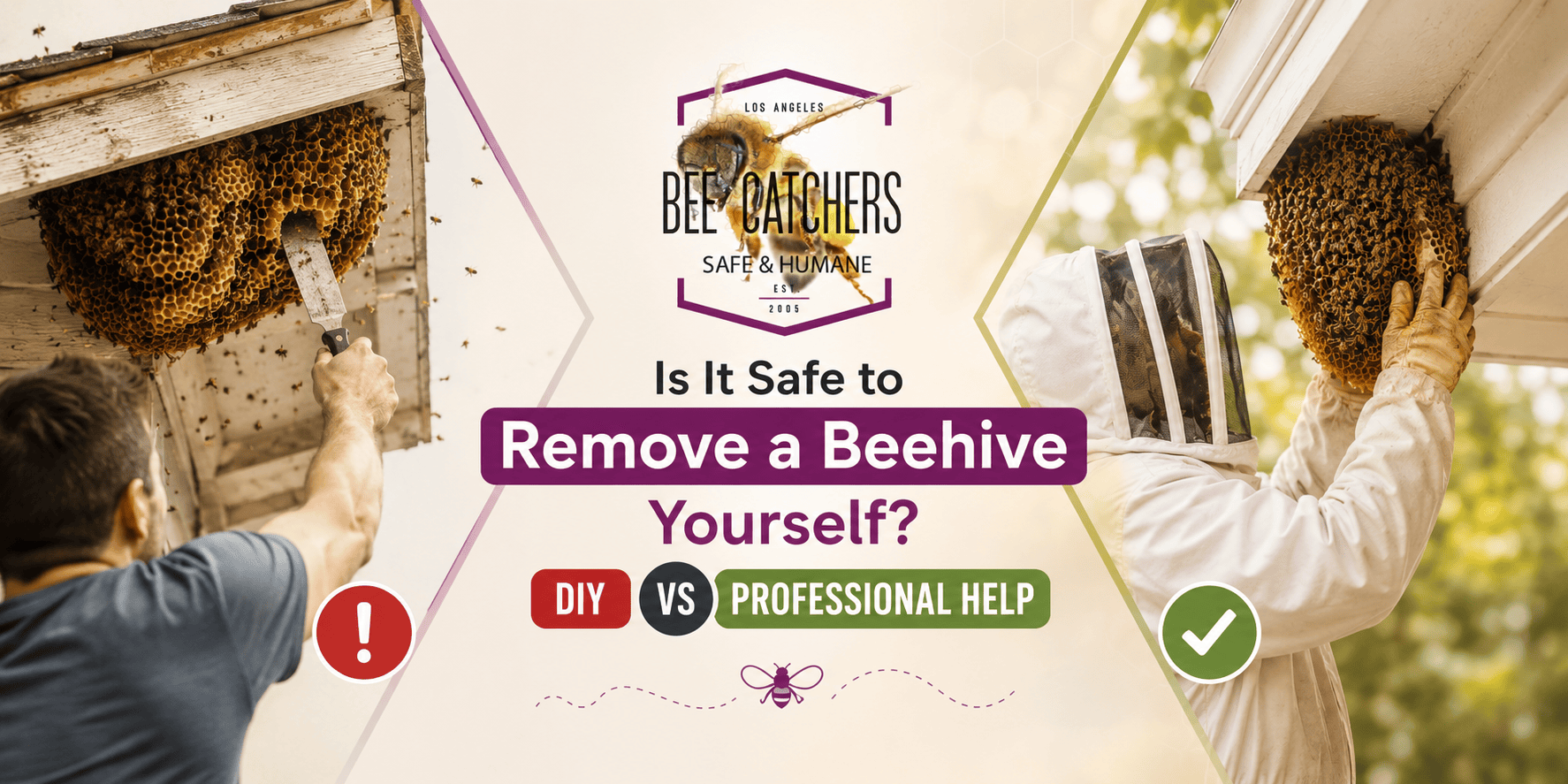
Is It Safe to Remove a Beehive Yourself? DIY vs Professional Help

Finding a beehive on your property can be alarming — especially when it’s tucked into a wall cavity, attic space, or tree in your backyard. Many homeowners across Southern California immediately search for a quick fix, wondering if they can simply knock the hive down or spray it themselves. But before you grab a ladder and a can of insecticide, it’s worth understanding exactly what you’re dealing with, and why bee removal in Los Angeles is a job best left to trained professionals.

In this guide, we’ll break down the real risks of DIY bee removal, when it might be appropriate, and why calling in experts for humane bee removal almost always saves you time, money, and potential injury.

Understanding the Real Risk of a Beehive

A single honeybee colony can contain anywhere from 10,000 to 60,000 bees. When a hive is disturbed incorrectly, bees don’t just get “annoyed” — they release alarm pheromones that trigger a coordinated defensive response from the entire colony. This is how amateur removal attempts turn into multiple-sting emergencies, sometimes requiring hospitalization.

This risk is especially high with Africanized honeybees, which are common throughout Southern California, including areas served by bee removal Orange County and bee removal Ventura County teams. Africanized bees are more defensive, respond faster to disturbances, and will chase perceived threats much farther than European honeybees. What looks like a manageable hive on the outside can, in reality, be a large, aggressive colony hidden behind stucco or drywall.

Why DIY Bee Removal Often Backfires

1. You Can’t See the Whole Hive

Bees frequently build inside wall voids, chimneys, attics, or underground. What you see from outside — a small cluster of bees near a vent or crack — is often just the entrance. The actual comb, brood, and honey stores can be several feet away, meaning DIY spray treatments rarely reach the source.

2. Store-Bought Pesticides Don’t Solve the Problem

Even if a pesticide kills the visible bees, it does nothing to remove wax comb, honey, and dead bees left inside a structure. This leftover material attracts pests, causes foul odors, can stain walls and ceilings, and often draws a brand-new swarm to the same spot within weeks. This is one of the biggest differences in the bee exterminator vs removal debate — extermination kills bees on contact but leaves the hive intact, while proper bee hive removal in LA clears out the entire structure.

3. Structural Damage

Cutting into drywall, siding, or roofing without knowing exactly where the comb sits often leads to unnecessary damage — and sometimes bees escaping into other parts of the home. Professionals doing bee nest removal in Los Angeles use inspection tools to locate the comb precisely before opening any surface.

4. Allergic Reactions and Emergency Situations

Even people without a known bee allergy can experience anaphylaxis after multiple stings. If a DIY attempt goes wrong, you may need emergency bee removal in LA or urgent medical care — a risk that isn’t worth taking to save a service fee.

5. Legal and Environmental Considerations

Honeybees are vital pollinators, and many California municipalities encourage relocation over extermination. A California licensed bee removal company follows safety and environmental regulations that DIY methods typically ignore.

When Might DIY Be Reasonable?

There are a few limited situations where handling bees yourself is lower-risk:

  • A small, temporary swarm resting on a branch or fence post (not yet inside a structure) may move on within 24–48 hours on its own.
  • No known allergies in the household, and the swarm is in a low-traffic area away from children, pets, or foot traffic.
  • You maintain distance and simply monitor rather than attempting removal.

Even in these cases, it’s smart to contact a beekeeper removal near me service for a phone consultation before acting, since a resting swarm can sometimes be safely relocated by a professional at no cost, especially if you’re near a residential zone that welcomes bee swarm removal in Los Angeles teams.

What Professional Bee Removal Actually Involves

A trained technician doesn’t just spray and leave. A proper residential bee removal or commercial bee removal job typically includes:

  1. Inspection – Using thermal imaging, sound detection, or visual inspection to locate the exact position of the comb within a wall, roof, or structure.
  2. Safe extraction – Opening the affected area carefully, removing bees (often alive, for relocation), and extracting all comb.
  3. Honeycomb removal – Complete honeycomb removal in Los Angeles to prevent melting wax, leaking honey, and secondary pest infestations.
  4. Sealing and repair guidance – Closing entry points so a new colony doesn’t move into the same cavity.
  5. Relocation – Reputable companies specializing in bee relocation in Los Angeles transport live colonies to apiaries or safe habitats rather than killing them outright.

This full-service approach is why eco friendly bee removal has become the preferred method for most homeowners — it solves the root problem instead of offering a temporary fix.

Humane Removal vs. Extermination

Many people assume “bee control” always means killing the colony, but that’s not the case anymore. A pest control bee specialist trained in humane methods will:

  • Avoid pesticides whenever a live colony can be safely extracted
  • Relocate bees to support local pollinator populations
  • Only recommend extermination in rare cases (e.g., inaccessible colonies posing immediate danger)

This distinction matters both ethically and practically — for the health of your local ecosystem and for avoiding the leftover-hive problems that come with spray-only extermination.

How Much Does Professional Bee Removal Cost?

Bee removal price in Los Angeles varies based on hive location, size, and accessibility. General ranges include:

  • Simple swarm removal: Often the most affordable, sometimes free if a beekeeper wants the swarm
  • Wall or attic hive removal: Mid-range pricing due to labor, inspection, and repair work
  • Large, established colonies or hard-to-reach spots (chimneys, high rooflines): Higher pricing due to equipment and time required

Always ask for a clear, itemized quote before work begins. A trustworthy company will explain removal, extraction, and any structural repair costs upfront — no surprise fees after the job starts.

Choosing the Right Bee Removal Company

When comparing services, look for:

  • Licensing and insurance — confirm they’re a California licensed bee removal provider
  • Experience with your specific issue — whether it’s a wall hive, attic colony, or active swarm
  • Live removal and relocation options, not just pesticide spraying
  • Local availability — companies serving bee removal Los Angeles, Orange County, and Ventura County should be familiar with regional bee behavior and building styles
  • Fast response times for situations requiring emergency bee removal LA

Final Verdict: DIY or Professional?

For a small, temporary, visible swarm with no signs of nesting, cautious observation may be enough. But for any hive that’s established inside a wall, roof, chimney, or other structure — or involves a large or aggressive colony — professional removal is the safer, more effective, and often more cost-efficient choice in the long run. DIY attempts frequently lead to incomplete removal, structural damage, or painful stings, while professionals handle the job safely, humanely, and permanently.

Frequently Asked Questions (FAQs)

Q1: Is it dangerous to remove a beehive myself? 

Yes. Disturbing a hive without proper equipment or training can trigger mass stinging, especially with Africanized honeybees common in Southern California. Multiple stings can cause severe allergic reactions even in people without a prior history of bee allergies.

Q2: How do I know if I need professional bee removal? 

If bees are entering and exiting a fixed point on your home (wall, roof, vent, chimney) rather than resting temporarily on a branch, it’s likely an established hive that requires professional extraction rather than a passing swarm.

Q3: What’s the difference between bee extermination and bee removal? 

Extermination kills bees using pesticides but leaves the comb and honey inside the structure, often causing odor and future infestations. Removal involves physically extracting the bees and comb, offering a permanent, humane solution.

Q4: Can I just spray a beehive with store-bought insecticide? 

It’s not recommended. Store-bought sprays often fail to reach hidden comb, can agitate the colony into an aggressive swarm, and leave behind wax and honey that attract pests and new bees.

Q5: Are honeybees protected in California? 

While honeybees aren’t formally endangered, many local pest control guidelines and beekeeper associations strongly encourage humane relocation over extermination due to their critical role in pollination.

Q6: How much does bee removal cost in Los Angeles? 

Pricing depends on hive size, location, and accessibility — a simple exterior swarm costs less than a hive embedded in a wall or attic. Most companies offer free phone estimates before dispatching a technician.

Q7: What happens to the bees after professional removal? 

Reputable, eco-friendly removal companies relocate live colonies to apiaries or safe outdoor environments rather than destroying them, supporting local pollinator populations.

Q8: How fast can I get emergency bee removal in LA? 

Most professional bee removal companies serving Los Angeles offer same-day or next-day emergency response, particularly for swarms in high-traffic areas or aggressive colonies near homes and businesses.

Q9: Do I need to repair my home after bee removal?

 Often, yes. Once comb and honey are extracted from a wall or attic, the entry point needs to be sealed properly to prevent water damage, pest issues, or a new swarm moving into the same cavity.

Q10: Is DIY bee removal ever safe? 

Only in very limited situations — such as a small, temporary swarm resting away from foot traffic, with no signs of nesting. Even then, contacting a local beekeeper for guidance before acting is the safer approach.

Need reliable, humane bee removal near you? Whether it’s a residential wall hive, a commercial property swarm, or an emergency situation, a licensed local specialist can safely assess and resolve the problem — protecting your home and the bees.

How to Choose a Licensed and Trustworthy Bee Removal Company in Los Angeles

Once you’ve found a hive on your property and decided you need professional help, a new question comes up fast: which company can you actually trust? A quick search for bee removal near me brings up dozens of options — some licensed specialists, some general pest control chains, and some fly-by-night operators with no real credentials at all.

Choosing the wrong company can mean overpaying, incomplete work, or bees returning within weeks. Here’s exactly what to check before you hire anyone for bee removal in Los Angeles.

1. Confirm They’re Actually Licensed

Bee and pest removal in California should be handled by licensed, bonded, and insured technicians. Before hiring, ask directly:

  • Are your technicians licensed and insured?
  • What happens if there’s accidental property damage during removal?

A legitimate licensed bee removal company will answer this without hesitation and can provide documentation if asked. This single question filters out a large number of unqualified operators immediately.

2. Ask Whether They Do Live Removal or Extermination

This is one of the biggest differences between bee removal companies, and it directly affects both cost and long-term results. Some companies only offer chemical extermination, which kills the colony but often leaves honeycomb behind to rot and attract secondary pests.

A trustworthy company will offer live bee removal — full extraction, honeycomb removal, and relocation rather than killing the colony. We cover this comparison in detail in our guide: Bee Removal vs Bee Extermination: Which One Should You Choose?

3. Check Reviews Across Multiple Platforms

Don’t rely on just one source. Before hiring a bee removal company in Los Angeles, check:

  • Google Reviews — look for consistency and recent activity, not just a high star rating
  • Yelp — often has more detailed, unfiltered feedback
  • BBB (Better Business Bureau) — accreditation and complaint history are both worth checking

A company with strong, consistent reviews across all three is a much safer bet than one with only a handful of reviews on a single platform.

4. Get a Written Quote — Not Just a Verbal Estimate

Bee removal cost can vary significantly based on hive size and location, so a legitimate company should be willing to inspect the job and provide a written quote before starting work. Be cautious of companies that give a vague price over the phone and then raise it significantly on-site. For a full breakdown of what to expect price-wise, see our guide on bee removal cost in Los Angeles.

5. Ask About Guarantees

A confident, experienced company will stand behind its work. Ask specifically:

  • What happens if bees return to the same spot?
  • Is structural repair included, or will I need to hire someone separately?

Companies offering a written guarantee (for example, a multi-year “bee free” warranty) are signaling that they do the job right the first time, including sealing entry points and repairing any structural damage.

6. Look for Experience With Africanized Bees

Southern California has a notable presence of Africanized bees, which are more defensive than typical honey bees and require additional training and caution to handle safely. Ask whether the company has specific experience identifying and safely removing Africanized colonies — this is not something every general pest control company is equipped for.

7. Watch for These Red Flags

  • No licensing information available when asked
  • Pushy, high-pressure sales tactics over the phone
  • Extremely low quotes with no mention of honeycomb removal
  • No reviews, or only reviews that all appear within the same short time window
  • Reluctance to provide anything in writing

Why This Matters Beyond Just Your Property

Choosing humane bee removal over extermination isn’t just about avoiding property damage — honey bees pollinate roughly 80% of the world’s food supply, and their populations have declined significantly in recent decades. A trustworthy company will relocate colonies rather than destroy them, supporting local beekeepers and pollinator populations in the process.

What to Expect From Bee Catchers

Bee Catchers has over 55 years of combined team experience, an in-house biologist, and has relocated more than 30,000 swarms and colonies without extermination — all through our nonprofit, the BeeQuilibrium Foundation. Every job includes full honeycomb removal, in-house structural repair when needed, and a 5-Year Bee Free Guarantee. You can review our track record directly on Google and Yelp before making a decision.

For a complete overview of the entire removal process from start to finish, see our Complete Guide to Bee Removal in Los Angeles County.

Frequently Asked Questions

How do I verify a company is actually licensed?

 Ask directly and request documentation. Reputable companies won’t hesitate to share this information.

Should I choose the cheapest quote? 

Not necessarily — a low quote that doesn’t include honeycomb removal or a guarantee can end up costing more in repeat visits or property damage.

Is it worth checking multiple review platforms? 

Yes. Google, Yelp, and BBB each capture slightly different feedback, and cross-checking gives a more accurate picture than relying on one source alone.

Do trustworthy companies serve areas outside Los Angeles proper? 

Many do — Bee Catchers, for example, also serves Orange County, Ventura County, San Bernardino, and Riverside. Check our Locations page for full coverage.

Ready to work with a licensed, trusted team? Contact Bee Catchers for a free inspection and written quote, or call 866.544.0074. Explore our bee and wasp removal services, or read more on bee removal cost and removal vs extermination.

Complete Guide to Bee Removal in Los Angeles County (2026)

If you’ve found a hive on your property, you’re probably searching for bee removal near me and trying to figure out what to do next — how urgent it is, what it will cost, and whether you should call a pest control company or a bee specialist. This guide covers everything homeowners and business owners across Los Angeles County need to know before making that call.

Why Bees Show Up on LA Properties

Southern California’s climate — mild winters, year-round flowering plants, and plenty of water sources in residential landscaping — makes it ideal territory for honey bee colonies. Bees are drawn to sheltered, dry spaces like:

  • Wall voids and attics
  • Chimneys and roof eaves
  • Sheds, water meter boxes, and irrigation valve covers
  • Trees, fences, and outdoor structures

Bee swarm season in Los Angeles typically runs from early spring through summer (March–August), when colonies split and scout for new nesting sites. This is when call volume for honey bee removal peaks across the county.

Step 1: Confirm You Actually Have Bees

Not every buzzing insect is a honey bee. Before calling anyone, it helps to know what you’re dealing with:

  • Honey bees — fuzzy, golden-brown, build wax honeycomb, usually calm unless disturbed
  • Africanized bees (“killer bees”) — nearly identical in appearance, but far more defensive; common in parts of Southern California
  • Wasps and yellow jackets — smoother, more slender, build paper nests rather than wax comb, and are far more aggressive by nature

If you’re unsure, don’t get close. A licensed technician (or even a photo sent ahead of time) can usually identify the species before the visit.

Step 2: Decide Between Bee Removal and Extermination

This is the most important decision in the entire process, and it affects both cost and long-term results. In short:

  • Extermination kills the colony but usually leaves the honeycomb behind, which can rot, leak, and attract secondary pests.
  • Live bee removal extracts and relocates the entire colony, including full honeycomb removal, and often includes structural repair.

We cover this in full detail in our dedicated guide: Bee Removal vs Bee Extermination: Which One Should You Choose?

For honey bees specifically, live removal is almost always the better long-term choice — both for your property and for local pollinator populations, since honey bees are responsible for pollinating roughly 80% of the world’s food supply.

Step 3: Understand What It Will Cost

Bee removal cost in Los Angeles varies widely depending on hive size, location (a wall cavity costs more than an open tree branch), and whether structural repair is needed. Generally, homeowners can expect anywhere from $150 for a small swarm removal up to $1,500+ for a large, established colony with honeycomb removal and repair work included.

For a full cost breakdown by job type, see our guide: How Much Does Bee Removal Cost in Los Angeles? (2026 Price Guide)

Step 4: Know What a Proper Bee Removal Job Includes

A complete, professional live bee removal service should include:

  1. Inspection — identifying the species, hive size, and access point
  2. Extraction — safe removal of bees and the queen using hands-on, non-chemical methods
  3. Honeycomb removal — removing all wax and honey to prevent future issues like ants, moths, rodents, and fermentation odor
  4. Relocation — transporting the colony to a sanctuary, apiary, or beekeeper rather than destroying it
  5. Structural repair — sealing entry points and repairing stucco, drywall, roofing, or siding if needed
  6. Guarantee — a warranty period in case bees attempt to return to the same spot

At Bee Catchers, this entire process is handled in-house, including structural repairs, and every job comes with a 5-Year Bee Free Guarantee.

Are Bees Dangerous? What You Should Know Before Removal

Most honey bees are not aggressive unless provoked, but Africanized bee removal requires extra caution due to their heightened defensive behavior. Regardless of species, DIY removal is not recommended — disturbing a hive without proper equipment is one of the most common ways people get stung, sometimes seriously. If you or a family member has a bee allergy, treat any active hive as an emergency and keep a safe distance until a licensed technician arrives.

What About Wasps and Yellow Jackets?

While this guide focuses on honey bees, many companies — including ours — also handle wasp removal and yellow jacket removal. Unlike honey bees, wasps and yellow jackets aren’t major pollinators, so extermination is typically the more appropriate method for these pests rather than live relocation.

Areas We Serve in Los Angeles County (and Beyond)

Bee Catchers provides humane bee removal throughout the greater Los Angeles metro area, including cities like Pasadena, Santa Monica, Burbank, Glendale, Long Beach, and Van Nuys, as well as Orange County, Ventura County, San Bernardino County, and Riverside. See our full Locations page to check coverage for your city.

How to Choose the Right Bee Removal Company

When comparing companies, look for:

  • State licensing — technicians should be licensed, bonded, and insured
  • Live removal, not just extermination — ask directly whether honeycomb is fully removed and bees are relocated
  • In-house structural repair — avoids delays and extra contractor costs
  • Written guarantees — protects you if bees return
  • Experience with Africanized bees — especially important in Southern California

Bee Catchers has over 55 years of combined team experience, an in-house biologist, and has relocated more than 30,000 individual swarms and colonies — all without extermination.

Have bees on your Los Angeles County property? Contact Bee Catchers for a free inspection and written quote, or call 866.544.0074. Explore our full bee and wasp removal services, read more on bee removal cost and removal vs extermination, or browse bee safety facts on our Bee Lore page.

Frequently Asked Questions

How fast can someone come remove a hive?

 Most reputable companies, including Bee Catchers, offer 7-day-a-week service and can often respond same-day for urgent situations.

Will removing the hive damage my property? 

Not if done properly. Access points are sealed and repaired as part of a complete removal job, which actually prevents further damage from occurring.

What happens to the bees after they’re removed?

 With a live removal service, colonies are relocated to sanctuaries, apiaries, or beekeepers — never killed.

Is it worth paying more for live removal instead of extermination? 

In most cases, yes. It prevents secondary damage from leftover honeycomb and supports local pollinator populations, often at a similar or even lower long-term cost.

Bee Removal vs Bee Extermination: Which One Should You Choose?

When bees show up on your property, you’ll usually come across two very different options: bee extermination or live bee removal. They sound similar, but the process, the outcome, and the long-term results are completely different. If you’re searching for bee removal near me, understanding this difference before you call anyone can save you money, protect your property, and — if you care about the environment — help preserve a species that’s critical to our food supply.

Here’s a clear breakdown of both, so you can decide what’s right for your situation.

What Is Bee Extermination?

Bee extermination typically involves spraying pesticides or chemical treatments directly into a hive to kill the colony. It’s often marketed as the faster, cheaper fix — and in some emergency situations, a general pest control company may be the only option available.

The problem: extermination only kills the bees. It usually does not include:

  • Removal of the honeycomb structure
  • Sealing entry points to prevent future infestations
  • Structural repair to walls, roofs, or stucco

That means even after the bees are gone, you’re often left with a wall full of dead bees, leaking honey, wax, and a smell that can attract ants, rodents, and other pests for months afterward.

What Is Live Bee Removal?

Live bee removal — also called humane bee removal — is a hands-on process where trained technicians safely extract the entire colony, including the queen, and relocate it rather than killing it. This is the approach we specialize in at Bee Catchers.

A proper honey bee removal job includes:

  • Careful extraction of bees and the queen
  • Full honeycomb removal to prevent leftover wax and honey from causing damage
  • Relocation of the colony to a sanctuary, apiary, or beekeeper
  • In many cases, structural repair (stucco, drywall, roofing) to close up the entry point for good

Because the colony is removed completely — not just killed in place — there’s little risk of the leftover hive causing secondary problems like mold, pest infestations, or wall damage down the line.

Side-by-Side Comparison

FactorBee ExterminationLive Bee Removal
Kills the colonyYesNo — relocated alive
Removes honeycombRarelyYes, always
Prevents future infestationsNot usuallyYes, with sealing/repair
Risk of leftover honey/wax damageHighLow
Environmentally friendlyNoYes
Structural repair includedRarelyOften, in-house
Long-term costCan be higher (repeat issues)Predictable, guaranteed

Why the “Cheaper” Option Often Costs More Later

This is the part most homeowners don’t find out until it’s too late. When a hive is exterminated but not physically removed, the leftover honeycomb removal work still has to happen eventually — because dead colonies decompose, leak, and attract secondary pests like ants, moths, and rodents. Property owners often end up calling a second company (or the same one, at extra cost) to finish the job that extermination didn’t cover.

If you want a full breakdown of what a proper job costs from start to finish, see our guide on bee removal cost in Los Angeles.

Are Bees Dangerous? Does That Change the Decision?

A common reason people jump straight to extermination is fear — especially around Africanized bees (often called “killer bees”), which are more defensive than typical European honey bees. It’s true these colonies require extra caution. But danger isn’t a reason to kill the colony — it’s a reason to call a licensed, trained professional rather than attempting removal yourself.

Our technicians are trained specifically to handle Africanized bee removal safely, using the same humane, live-relocation process. You don’t have to choose between safety and doing the right thing for the bee population — a qualified team can give you both.

What About Wasps and Yellow Jackets?

It’s worth noting this comparison mainly applies to honey bees, which are pollinators worth protecting. Wasps and yellow jackets are a different category — they aren’t pollinators in the same critical way, and wasp removal or yellow jacket removal is typically handled differently (and extermination is more commonly appropriate for these pests). A good bee removal company will be able to correctly identify what you’re dealing with before recommending a method.

Why Bee Catchers Chooses Live Removal — Always

Bee Catchers was founded on the belief that relocation, not extermination, is the responsible path forward. Honeybees pollinate roughly 80% of the world’s food supply, and their populations have already declined significantly over the past several decades. Every colony we remove is relocated — never exterminated — through our nonprofit, the BeeQuilibrium Foundation, where bees go on to support beekeepers, orchards, and farms.

We back every job with a 5-Year Bee Free Guarantee: if bees return to the same spot, we come back and fix it at no charge.

Have bees on your property and not sure which option is right for you? Contact Bee Catchers for a free inspection — call 866.544.0074. See our full bee and wasp removal services, check if we cover your area on our locations page, or explore more bee safety facts on our Bee Lore page.

Frequently Asked Questions

Is extermination ever the right choice? 

For honey bees, rarely — live removal is almost always safer long-term and better for the environment. For wasps or yellow jackets, extermination is more commonly appropriate.

Is live bee removal more expensive? 

Not necessarily upfront, and it often saves money long-term since it prevents repeat issues from leftover honeycomb.

Can I remove a beehive myself instead of choosing either option? 

It’s not recommended. Without training, DIY removal attempts can provoke the colony and lead to stings, especially with Africanized bees.

How do I know if I have honey bees or something else? 

Send us a photo before your appointment — our in-house biologist and technicians can usually identify the species before we even arrive.

How Much Does Bee Removal Cost in Los Angeles? (2026 Price Guide)

If you’ve spotted a hive on your property and started searching for bee removal near me, one of the first questions on your mind is probably: how much is this going to cost?

The honest answer is — it depends. Bee removal cost in Los Angeles typically ranges anywhere from $200 to $1,500+, depending on the size of the colony, where it’s located, and whether structural repair is needed afterward. In this guide, we’ll break down exactly what affects that price, so you know what to expect before you make a call.

Average Bee Removal Cost in Los Angeles (2026)

Here’s a general breakdown of what homeowners across Southern California typically pay for live bee removal:

Job TypeEstimated Cost Range
Small exterior swarm removal$150 – $300
Established hive removal (accessible area)$300 – $600
Beehive in wall removal or roofline$600 – $1,200
Large colony with full honeycomb removal$800 – $1,500+
Structural repair (stucco, drywall, roofing)Quoted separately, based on damage

These numbers reflect general industry ranges — the best way to get an accurate number for your specific situation is a free inspection. Contact Bee Catchers and we’ll give you a straightforward quote, with written guarantees and no hidden fees.

What Affects the Cost of Bee Removal?

1. Location of the Hive

A swarm hanging visibly from a tree branch is a quick, low-cost job. But a colony that has built deep inside a wall cavity, chimney, or under roof tiles requires more time, tools, and sometimes minor construction work — which raises the price.

2. Size and Age of the Colony

A colony that has been established for months (or years) will have a much larger honeycomb structure. Removing all of it — not just the bees — is critical, because leftover honeycomb can attract pests, ants, and even rodents later on. Learn more about why this matters in our guide on honeycomb removal.

3. Type of Bee or Insect

Not every stinging insect job is priced the same:

  • Honey bee removal is generally more involved because of live relocation requirements.
  • Africanized bee removal (sometimes called “killer bees”) often requires extra safety precautions due to their defensive behavior, which can affect pricing.
  • Wasp removal in Los Angeles and yellow jacket removal are usually priced differently than honey bee jobs since these insects don’t require the same relocation process.

4. Structural Repairs

If bees have been in a wall or roof for a long time, removal alone isn’t enough — repairs to stucco, drywall, fascia, or siding may be necessary to prevent future infestations. Bee Catchers handles this in-house rather than outsourcing it, which keeps the process faster and often more affordable than hiring separate contractors.

5. Emergency or Same-Day Service

Most companies, including ours, offer 7-day-a-week availability. Same-day or emergency calls may carry a small additional service fee compared to scheduled appointments.

Bee Removal vs. Bee Extermination: Why It Matters for Pricing (and the Planet)

Many pest control companies offer cheaper “extermination” — but this simply kills the colony rather than relocating it. It might look like the more affordable option upfront, but it comes with real downsides:

  • Dead colonies left inside walls can rot, leak honey, and attract secondary pests
  • It does nothing to protect local bee populations, which pollinate roughly 80% of the world’s food supply
  • It often doesn’t include structural repair, meaning you’ll pay separately later anyway

Live bee removal, like the service we provide, costs a bit more upfront in some cases — but it includes full honeycomb removal, relocation to our nonprofit sanctuary through the BeeQuilibrium Foundation, and a 5-year guarantee that bees won’t return to the same spot. Long-term, it’s usually the smarter investment.

Areas We Serve Across Southern California

Pricing can vary slightly depending on your location, but our licensed technicians serve homeowners and businesses throughout the greater Los Angeles metro area, including Orange County, Ventura County, San Bernardino County, and Riverside. Check our full list of service locations to see if we cover your city.

How to Get an Accurate Quote

Because every bee removal job is different, the best way to get a real number — not just an estimate — is a quick inspection. Here’s what to expect when you call Bee Catchers:

  1. Free phone consultation — describe what you’re seeing and where
  2. On-site inspection — our licensed technician assesses hive size, location, and access
  3. Written quote — no surprises, and we’ll beat any licensed competitor’s price in writing
  4. Same-week or emergency scheduling — available 7 days a week

Have bees on your property? Get in touch with Bee Catchers for a free inspection and honest, written quote — or call 866.544.0074. Learn more about our full range of bee and wasp removal services, or read more bee facts and safety tips on our Bee Lore page.

Frequently Asked Questions

Is bee removal cheaper than pest control extermination? 

Not always. Extermination quotes can look lower initially, but they don’t include relocation, honeycomb removal, or structural repair — costs that often show up later.

Does bee removal cost more in winter? 

Not necessarily, but colony size (and therefore cost) tends to be smaller in early spring before swarm season picks up.

Do you charge for the inspection? 

We offer inspections as part of our process to give you an accurate, written quote before any work begins.

What if the bees come back? 

Every job comes with our 5-Year Bee Free Guarantee — if bees return to the same location, we come back at no additional cost.