
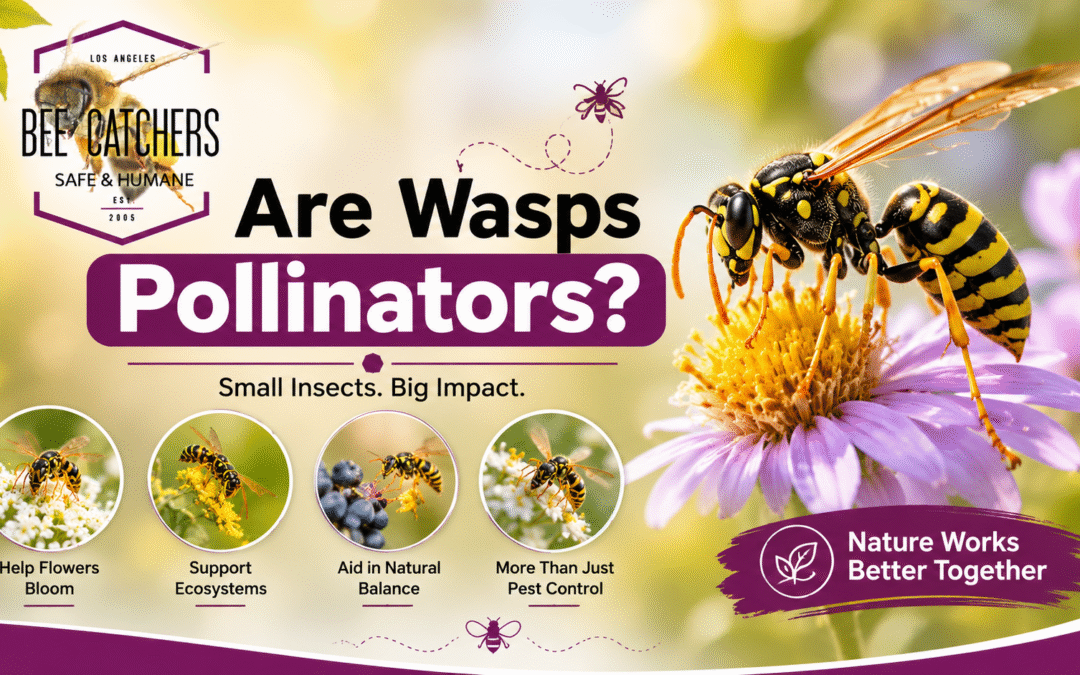
If you’ve ever watched a black-and-yellow insect hover near your patio flowers and wondered whether it was helping your garden or just crashing your backyard barbecue, you’re not alone. It’s one of the most common questions the team at Bee Catchers, Inc hears from homeowners across Southern California: are wasps pollinators, or are they simply pests that look like bees?
The honest answer is a little more nuanced than a flat “yes” or “no.” Wasps can move pollen from flower to flower, but they aren’t built for the job the way honeybees are, and their role in your garden is very different from the role a bee colony plays. Understanding that difference matters, because it changes how you should react when you spot a nest on your property.
At Bee Catchers, Inc, we’ve spent decades removing and relocating stinging insects across the greater Los Angeles area, and one thing we see constantly is confusion between wasps and bees. That confusion often leads to the wrong call — literally. People spray a beneficial honeybee colony with pesticide, or they try to knock down an aggressive wasp nest themselves and end up with multiple stings. This guide is here to clear things up once and for all.
So, Are Wasps Pollinators?
Technically, yes — wasps are considered incidental pollinators. As they move from flower to flower feeding on nectar, tiny amounts of pollen stick to their bodies and get transferred along the way. Some wasp species, like fig wasps, even have a highly specialized pollination relationship with specific plants that couldn’t reproduce without them.
However, wasps are nowhere near as effective as bees when it comes to pollination, and here’s why:
- Wasps have smooth, mostly hairless bodies. Bees are covered in branched, fuzzy hairs specifically designed to trap and carry pollen grains. Wasps lack this feature almost entirely, so far less pollen sticks to them.
- Wasps aren’t dedicated flower feeders. Most wasps are predatory or scavenging insects. They visit flowers occasionally for a nectar snack, but they spend much of their time hunting other insects, scavenging meat, or foraging around trash cans — not systematically working through a garden bed the way a honeybee does.
- Wasps don’t have pollen-carrying structures. Bees have specialized pollen baskets (corbiculae) on their hind legs to intentionally collect and transport pollen back to the hive. Wasps have no such structure because pollen collection isn’t part of their biological purpose.
So while it’s fair to say wasps play a minor, incidental role in pollination, they are not considered reliable or essential pollinators the way honeybees are. If wasps disappeared tomorrow, most food crops would be just fine. If honeybees disappeared, global agriculture would be in serious trouble — a distinction the team at Bee Catchers, Inc takes seriously in everything we do.
Wasps vs Bees: Breaking Down the Real Differences
The wasps vs bees debate comes up constantly, and it’s easy to see why — both insects are yellow and black, both can sting, and both show up around the same flowers and picnic tables. But once you know what to look for, telling them apart becomes second nature.
Body Shape and Appearance
- Bees are round, plump, and fuzzy. Their bodies are built to hold pollen, and you can often see pollen sacs on their hind legs.
- Wasps have slender, smooth, almost polished-looking bodies with a distinct narrow “waist” separating the thorax from the abdomen.
Behavior
- Bees are generally calm and focused on flowers. A honeybee that stings usually dies afterward, since its barbed stinger stays lodged in the skin — which means bees typically avoid stinging unless truly threatened.
- Wasps are more aggressive, especially in late summer and early fall when natural food sources dry up and they start scavenging around homes for sugar and protein. Unlike bees, wasps can sting repeatedly without dying.
Diet
- Bees feed almost exclusively on nectar and pollen.
- Wasps are largely predatory or scavenging, feeding on other insects, spiders, and scraps of human food — which is part of why they’re actually helpful for natural pest control in gardens, even if they aren’t great pollinators.
Nesting Habits
- Bees build wax comb hives in tree hollows, wall cavities, chimneys, or man-made boxes.
- Wasps build nests from a papery material they create by chewing wood fibers, often underground, in wall voids, under eaves, or hanging from tree branches.
If you’re staring at an insect and trying to figure out which category it falls into, our team at Bee Catchers, Inc has already broken this down in detail in our guide on bees vs. yellow jackets, which covers one of the most commonly confused wasp species side by side with honeybees.
What Does a Common Wasp Nest Look Like?
Recognizing a common wasp nest is one of the fastest ways to protect yourself and your family from an unpleasant surprise. Unlike a honeybee hive, which is made of golden wax comb, wasp nests are constructed from a gray, papery material that resembles thin cardboard. Wasps create this material by chewing up wood fibers and mixing them with their saliva.
Common wasp nest locations include:
- Underground burrows, often repurposed from abandoned rodent holes
- Inside wall voids or attic spaces, where the nest can grow undetected until it’s quite large
- Under roof eaves, deck overhangs, or porch ceilings
- Hanging from tree branches or shrubs, shaped like an upside-down teardrop or football
- Inside sheds, garages, or unused outdoor furniture
A mature wasp nest can house hundreds of wasps by late summer, which is exactly why nests tend to seem to “appear out of nowhere” — they start small in spring and grow rapidly through the warmer months. If you spot papery layers rather than wax comb, you’re very likely dealing with a wasp colony rather than a beehive, and the removal approach should be different.
For homeowners who are still unsure what they’re looking at, browsing real examples in our photo gallery can help you compare what you’ve found on your property against confirmed nest photos before deciding on next steps.
Black Wasp with White Stripes: What Species Is It?
One of the more frequently searched identification questions we get is about a black wasp with white stripes. This description most commonly points to one of a few species found throughout California:
- Bald-faced hornets — despite the name, these are actually a type of wasp, not a true hornet. They have a mostly black body with distinctive white or ivory markings on the face and the tip of the abdomen. They build large, enclosed, gray paper nests, often high in trees or attached to the sides of buildings.
- White-banded wasps and certain thread-waisted wasp species also display bold black-and-white coloring rather than the more familiar yellow-and-black pattern.
- Some spider wasps and mud dauber species can also appear predominantly dark with pale banding, depending on the species and region.
Black-and-white patterned wasps tend to be just as capable of stinging as their yellow-and-black cousins, and bald-faced hornets in particular are known for being highly defensive around their nests. If you’ve spotted one of these insects repeatedly around your property, it’s worth having a professional confirm the species before deciding how to handle it — misidentifying an aggressive nest-builder as a harmless insect is a common (and painful) mistake.
What Does a Wasp Look Like, Exactly?
For homeowners trying to answer the basic question of what does a wasp look like, here’s a quick physical rundown that applies to most common species:
- Narrow, defined waist connecting the thorax and abdomen — this is one of the clearest giveaways
- Smooth, shiny exoskeleton with little to no visible body hair
- Long, slender legs that often dangle visibly during flight
- Two pairs of wings, which fold neatly along the body at rest
- Coloring that varies by species — most people picture the classic yellow-and-black pattern, but as covered above, some wasps are black with white or pale markings instead
Behaviorally, wasps also tend to fly in a faster, more erratic, darting pattern compared to the slower, more deliberate flight of a foraging bee. If you see an insect zig-zagging aggressively around your trash cans or soda cans at a backyard gathering, that erratic flight pattern alone is often a strong clue you’re dealing with a wasp rather than a bee.
Wasps and Bees in Photos: Side-by-Side Comparison
Because written descriptions only go so far, many homeowners searching for photos of bees and wasps are really trying to do a visual double-check before deciding how to respond to an insect on their property. When comparing photos side by side, focus on these details:
- Body texture — fuzzy and round (bee) vs. smooth and slender (wasp)
- Waist definition — barely visible (bee) vs. sharply pinched (wasp)
- Leg appearance — often carrying visible pollen (bee) vs. bare, dangling legs (wasp)
- Nest material visible in the background — golden wax comb (bee) vs. gray papery material (wasp)
The Bee Catchers, Inc team regularly documents real hives and nests we’ve encountered across Los Angeles, Orange, Ventura, and Riverside Counties, and our photo gallery is a great free resource if you want to compare your own backyard sighting against confirmed images before making a decision.
What Is a Bumblebee Wasp?
Another search that trips people up is the term bumblebee wasp. This isn’t an official scientific classification — it’s a common nickname people use for a couple of different things:
- Wasps that mimic bumblebees in coloring and body shape as a survival strategy, since predators tend to avoid the more heavily defended bumblebee. This is a form of Batesian mimicry, where a harmless or less-defended species evolves to resemble a more dangerous one.
- Certain velvet ant species (which are technically wingless wasps, not ants) are sometimes described this way due to their fuzzy, rounded appearance combined with wasp-like stinging capability.
- Some people also use the term loosely to describe large, robust wasp species that are chunkier than the typical slender wasp body type, giving them a bumblebee-like silhouette at a glance.
The key takeaway is that a “bumblebee wasp” is generally a wasp species that has evolved to look like a bumblebee for protective purposes, not an actual hybrid or bee species. If you’re unsure whether something buzzing around your yard is a true bumblebee or a bumblebee-mimicking wasp, closer inspection of the waist (bumblebees don’t have a pinched waist; wasps do) is usually the fastest way to tell.
Why This Distinction Matters for Removal Decisions
This isn’t just a fun biology lesson — correctly identifying what’s on your property has real consequences. Because honeybees are essential pollinators responsible for a huge share of the food we eat, Bee Catchers, Inc specializes in humane, live removal and relocation rather than extermination. Every colony we remove is relocated through our nonprofit partner, the BeeQuilibrium Foundation, so the bees can continue their critical pollination work at farms, orchards, and apiaries.
Wasps, on the other hand, are typically not relocated as a colony. Since they aren’t essential pollinators and can pose a higher risk to people and pets — especially aggressive species like yellow jackets and bald-faced hornets — nests are usually addressed as a pest control matter rather than a conservation effort.
That’s exactly why getting the identification right matters before anyone reaches for a spray can or calls the wrong kind of service. Treating a beneficial honeybee hive like a pest problem can result in the unnecessary loss of a pollinator colony, while underestimating an aggressive wasp nest can lead to painful, repeated stings.
What to Do If You Find a Nest on Your Property
If you’ve discovered a nest and you’re not sure whether you’re dealing with bees or wasps, here’s the safest path forward:
- Keep your distance. Don’t spray, poke, or disturb the nest while you’re still trying to identify it.
- Observe from a safe spot. Note the nest material (wax vs. paper), its location, and the insects’ flight pattern.
- Take a photo if it’s safe to do so. A clear picture helps a professional identify the species remotely before a visit.
- Call a licensed professional. Our team at Bee Catchers, Inc can quickly tell you what you’re dealing with, whether it’s a honeybee colony that needs humane relocation or a wasp nest that calls for a different approach.
- Skip the DIY sprays. Store-bought insecticides are often ineffective against an established nest and can trigger a defensive swarm response.
You can check our full range of bee removal services or see if we cover your area on our locations page. If you’d rather just get someone on the phone, our contact page has everything you need to reach our licensed, uniformed technicians directly.
Final Thoughts
So, are wasps pollinators? In a limited, incidental sense — yes, but they’re nowhere near as important to our food supply as honeybees. Wasps play their own valuable role in nature by controlling other insect populations, but when it comes to pollinating the flowers, fruits, and vegetables we depend on, that job belongs almost entirely to bees.
Whether you’re trying to identify a common wasp nest, figure out what a black wasp with white stripes actually is, or simply settle the wasps vs bees debate once and for all, knowing the difference protects both your family and the pollinators our ecosystem relies on. And whenever you’re unsure, the team at Bee Catchers, Inc is just a phone call away, ready to correctly identify what’s on your property and recommend the safest way to handle it.
Frequently Asked Questions
Q1: Are wasps considered pollinators?
Wasps can transfer small amounts of pollen while feeding on nectar, so they’re considered incidental pollinators. However, their smooth bodies and lack of pollen-carrying structures make them far less effective than bees, which are specially adapted for the job.
Q2: What’s the main difference between wasps and bees?
Bees are fuzzy, round, and focused on collecting pollen and nectar, while wasps have slender, smooth bodies with a narrow waist and are largely predatory or scavenging insects. Behaviorally, bees are generally calmer, while wasps tend to be more aggressive.
Q3: What does a common wasp nest look like?
A typical wasp nest is made of a gray, papery material created from chewed wood fibers, often shaped like an upside-down teardrop. Nests can be found underground, in wall voids, under eaves, or hanging from trees.
Q4: What kind of wasp is black with white stripes?
A black wasp with white markings is often a bald-faced hornet, which despite its name is actually a wasp species. It has a black body with white facial and abdominal markings and builds large, enclosed paper nests.
Q5: What does a wasp look like compared to a bee?
Wasps have smooth, shiny bodies, a distinctly narrow waist, and long dangling legs, while bees appear fuzzy and rounder with visible pollen sacs on their legs. Wasps also tend to fly in a faster, more erratic pattern.
Q6: Is a bumblebee wasp a real species?
“Bumblebee wasp” isn’t an official scientific term — it usually refers to a wasp species that mimics a bumblebee’s coloring and shape for protection, or occasionally to fuzzy, wingless wasps like velvet ants.
Q7: Should a wasp nest be relocated like a beehive?
Generally, no. Because wasps aren’t essential pollinators and can pose a higher safety risk, their nests are usually treated as a pest control issue rather than relocated as a live colony, unlike honeybee hives.
Q8: How can I tell if it’s a bee or wasp nest without getting close?
Look at the material: honeybee hives show golden wax comb, while wasp nests appear as gray, papery layers. You can also observe flight pattern from a distance — bees are slower and more deliberate, wasps are faster and more erratic.
Q9: Why do wasps show up around food and trash more than bees?
Wasps are scavengers as well as predators, so they’re drawn to sugary drinks, meat, and garbage, especially in late summer when natural food sources become scarce. Bees are primarily interested in flowers and nectar.
Q10: Who should I call if I find a nest and I’m not sure what it is?
Contact a licensed professional like Bee Catchers, Inc for identification and safe removal. Our team can determine whether you’re dealing with a honeybee colony that qualifies for humane relocation or a wasp nest that needs a different removal approach.
Not sure whether you’re dealing with bees or wasps? Contact the licensed team at Bee Catchers, Inc for a fast, professional identification and safe removal — protecting both your family and the pollinators our ecosystem depends on.
Recent Comments