
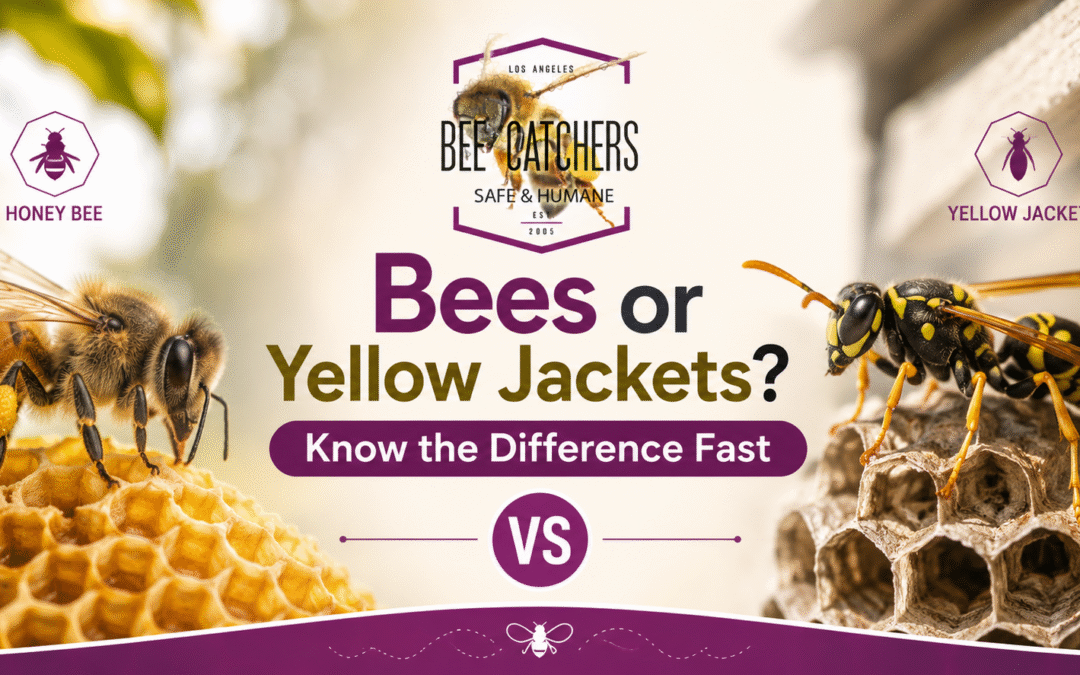
If you spot a stinging insect buzzing around your yard, patio, or trash can, your first instinct might be to assume it’s “just a bee.” But not every black-and-yellow flying insect is a honeybee — and mistaking one for the other can lead to the wrong reaction, the wrong home remedy, or worse, unnecessary property damage. Understanding the difference in the bee versus yellow jacket debate isn’t just trivia — it directly affects how you should respond if you find a nest, and whether the situation calls for humane relocation or professional pest management.
This guide breaks down exactly how to tell them apart quickly, why it matters, and what to do if you’ve found a colony on your property.
Why People Confuse Bees and Yellow Jackets
At a glance, both insects share a similar yellow-and-black color pattern and a similar size, which is why so many homeowners search for honey bee vs yellow jacket comparisons after spotting an insect near their home. But biologically, they’re quite different. Honeybees are gentle pollinators that build wax comb structures, while yellow jackets are aggressive wasps that build paper-like nests and are far more likely to sting without much provocation.
Getting the identification wrong matters because the response is completely different: a honeybee colony should be relocated by a licensed bee removal specialist, while a yellow jacket nest is typically better handled through pest control methods, since yellow jackets are not pollinators in the same critical way honeybees are and cannot usually be safely relocated as a live colony.
Bees vs. Yellow Jackets: Physical Appearance
| Feature | Honeybee | Yellow Jacket |
| Body shape | Round, fuzzy, robust | Slim, smooth, narrow waist |
| Color | Golden-brown and black, fuzzy stripes | Bright yellow and black, glossy |
| Hair | Covered in fine hair (helps pollen stick) | Little to no hair |
| Legs | Often carry visible pollen sacs | No pollen sacs |
| Flight pattern | Slower, more deliberate | Fast, erratic, darting |
When people ask, “are yellow jackets bees,” the short answer is no — yellow jackets are actually a type of wasp, not a bee species at all, despite the visual similarity that causes confusion.
Behavioral Differences
This is where the yellow jacket versus honey bee comparison becomes most important for homeowners:
Honeybees
- Generally calm and non-aggressive unless the hive is directly disturbed
- Sting only once (they die afterward), so they’re less likely to attack repeatedly
- Focused on collecting nectar and pollen from flowers
- Build hives in wall cavities, trees, chimneys, or man-made boxes
Yellow Jackets
- Aggressive, especially in late summer and fall when food sources become scarce
- Can sting multiple times without dying
- Attracted to sugary drinks, meat, and garbage — often seen around picnics, trash cans, and outdoor dining areas
- Build nests underground, in wall voids, or in attics, often out of a papery material made from chewed wood fibers
If you’ve noticed a yellow jacket and bee both hovering near a structure but behaving very differently — one calmly working flowers, the other aggressively swarming near food — that behavioral gap is one of the clearest ways to tell them apart without getting close enough to risk a sting.
Nest Differences
Nest structure is one of the most reliable ways to identify which insect you’re dealing with:
- Honeybee hives are made of wax and consist of visible hexagonal comb, often found inside wall cavities, tree hollows, or chimneys. The comb may be visible if the hive is exposed.
- Yellow jacket nests are made of a paper-like material and are often built underground in abandoned rodent burrows, inside wall voids, or hanging from eaves and attics. They typically have a single visible entrance hole.
If you’re staring at gray, papery layers rather than golden wax comb, you’re very likely looking at a wasp nest rather than a beehive.
Why the Difference Matters for Removal
This is the most practical reason to correctly identify what you’re dealing with. In the honey bees vs yellow jackets comparison, the recommended course of action is completely different:
- Honeybees are protected pollinators. A licensed, humane bee removal specialist can safely extract and relocate the colony rather than exterminating it, which supports local ecosystems and food production.
- Yellow jackets are not typically relocated as a colony and are usually treated as a pest control issue, since their aggressive behavior poses a higher risk to people and pets, especially near homes, schools, and outdoor gathering spaces.
Misidentifying a honeybee hive as a yellow jacket nest (or vice versa) can lead to unnecessary use of pesticides on a beneficial pollinator species, or an underestimation of the danger posed by an aggressive wasp colony.
What to Do If You Find a Nest
- Keep your distance. Don’t approach, spray, or disturb the nest before identifying it.
- Observe from a safe distance. Note the shape of the nest, the insects’ behavior, and their flight pattern.
- Take a photo if possible from a safe distance to help a professional identify the species before arriving.
- Call a professional. A trained technician can confirm whether you’re dealing with bees or yellow jackets and recommend the safest removal method. Our team handles live bee removal and relocation across the region and can quickly tell you what you’re dealing with over the phone or during an inspection.
- Avoid DIY sprays, especially store-bought insecticides, which are often ineffective against a fully established nest and can provoke a swarm response.
If you’re unsure which insect you’re dealing with, browse our photo gallery for real examples of hives and nests we’ve encountered, or check our service locations to see if we cover your area.
Quick Identification Checklist
Ask yourself these questions when trying to identify a stinging insect:
- Is it fuzzy or smooth? Fuzzy = honeybee. Smooth and shiny = yellow jacket.
- Is it near flowers or near food/trash? Flowers = honeybee. Food, soda cans, or garbage = yellow jacket.
- Is the nest made of wax or paper? Wax comb = honeybee. Papery, gray material = yellow jacket.
- Is it calm or aggressive? Calm and focused = honeybee. Erratic and defensive = yellow jacket.
- Where is the nest located? Wall cavities, trees, chimneys = often bees. Underground holes, eaves, attics = often yellow jackets.
Final Thoughts
While a yellowjacket vs honey bee mix-up is an easy mistake to make from a distance, taking a moment to observe body shape, behavior, and nest material can help you respond safely and appropriately. Honeybees deserve protection and relocation given their essential role in pollination, while yellow jackets require a different, more pest-control-focused approach due to their aggressive nature. Either way, the safest first step is always the same: keep your distance and call a professional who can correctly identify the species and handle removal safely.
Frequently Asked Questions (FAQs)
Q1: What is the easiest way to tell a bee from a yellow jacket? Look at the body: honeybees are fuzzy, golden-brown, and rounder, while yellow jackets are smooth, shiny, bright yellow, and have a narrow waist. Behavior is another clue — bees are calmer, while yellow jackets are more aggressive and erratic.
Q2: Are yellow jackets a type of bee? No. Despite the similar coloring, yellow jackets are a type of wasp, not a bee species. They belong to a completely different insect family and behave very differently from honeybees.
Q3: Which is more dangerous, a bee or a yellow jacket? Yellow jackets are generally considered more dangerous because they can sting multiple times and are more aggressive, especially in late summer and fall. Honeybees typically only sting once and are less likely to attack unprovoked.
Q4: How can I tell the difference between a beehive and a yellow jacket nest? Beehives are made of wax and form visible hexagonal comb, often found in wall cavities or trees. Yellow jacket nests are made of a papery material and are commonly found underground, in wall voids, or hanging from eaves.
Q5: Why are yellow jackets attracted to my backyard but not bees? Yellow jackets are drawn to sugary drinks, meat, and garbage, making backyards with food, trash cans, or outdoor dining areas more attractive to them. Honeybees are primarily interested in flowers and nectar sources.
Q6: Should I remove a yellow jacket nest myself? It’s not recommended. Yellow jackets are aggressive and can sting repeatedly, making DIY removal risky. A pest control professional is better equipped to handle an active nest safely.
Q7: Can a yellow jacket nest be relocated like a beehive? Generally, no. Unlike honeybee colonies, which are frequently relocated by professionals due to their pollinator status, yellow jacket nests are usually treated as a pest issue rather than relocated as a live colony.
Q8: Do honeybees and yellow jackets build nests in the same places? Sometimes, but there are common patterns: honeybees often nest in wall cavities, chimneys, and trees, while yellow jackets frequently nest underground or in attic spaces and eaves.
Q9: How many times can a yellow jacket sting compared to a bee? Yellow jackets can sting multiple times because their stinger doesn’t detach. Honeybees typically sting only once, since their stinger and venom sac remain in the skin, ultimately killing the bee.
Q10: What should I do if I’m not sure whether it’s a bee or a yellow jacket nest? Keep a safe distance, avoid spraying or disturbing it, and contact a professional for identification and safe removal. A trained technician can quickly confirm the species and recommend the right next step.
Not sure what’s nesting on your property? Contact our licensed team for a fast, professional identification and safe removal — whether it’s honeybees or another stinging insect.
Recent Comments