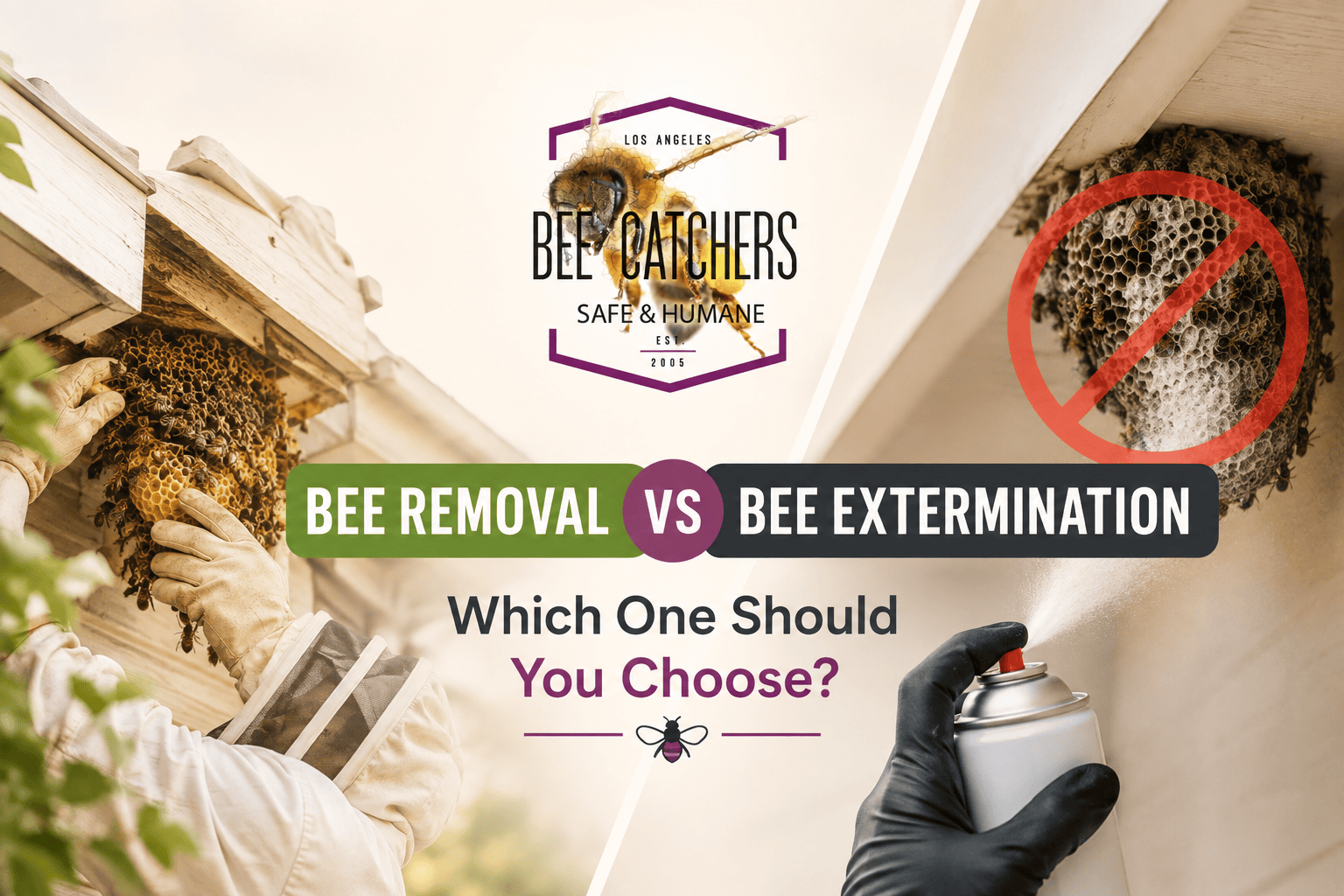
When bees show up on your property, you’ll usually come across two very different options: bee extermination or live bee removal. They sound similar, but the process, the outcome, and the long-term results are completely different. If you’re searching for bee removal near me, understanding this difference before you call anyone can save you money, protect your property, and — if you care about the environment — help preserve a species that’s critical to our food supply.
Here’s a clear breakdown of both, so you can decide what’s right for your situation.
What Is Bee Extermination?
Bee extermination typically involves spraying pesticides or chemical treatments directly into a hive to kill the colony. It’s often marketed as the faster, cheaper fix — and in some emergency situations, a general pest control company may be the only option available.
The problem: extermination only kills the bees. It usually does not include:
- Removal of the honeycomb structure
- Sealing entry points to prevent future infestations
- Structural repair to walls, roofs, or stucco
That means even after the bees are gone, you’re often left with a wall full of dead bees, leaking honey, wax, and a smell that can attract ants, rodents, and other pests for months afterward.
What Is Live Bee Removal?
Live bee removal — also called humane bee removal — is a hands-on process where trained technicians safely extract the entire colony, including the queen, and relocate it rather than killing it. This is the approach we specialize in at Bee Catchers.
A proper honey bee removal job includes:
- Careful extraction of bees and the queen
- Full honeycomb removal to prevent leftover wax and honey from causing damage
- Relocation of the colony to a sanctuary, apiary, or beekeeper
- In many cases, structural repair (stucco, drywall, roofing) to close up the entry point for good
Because the colony is removed completely — not just killed in place — there’s little risk of the leftover hive causing secondary problems like mold, pest infestations, or wall damage down the line.
Side-by-Side Comparison
| Factor | Bee Extermination | Live Bee Removal |
| Kills the colony | Yes | No — relocated alive |
| Removes honeycomb | Rarely | Yes, always |
| Prevents future infestations | Not usually | Yes, with sealing/repair |
| Risk of leftover honey/wax damage | High | Low |
| Environmentally friendly | No | Yes |
| Structural repair included | Rarely | Often, in-house |
| Long-term cost | Can be higher (repeat issues) | Predictable, guaranteed |
Why the “Cheaper” Option Often Costs More Later
This is the part most homeowners don’t find out until it’s too late. When a hive is exterminated but not physically removed, the leftover honeycomb removal work still has to happen eventually — because dead colonies decompose, leak, and attract secondary pests like ants, moths, and rodents. Property owners often end up calling a second company (or the same one, at extra cost) to finish the job that extermination didn’t cover.
If you want a full breakdown of what a proper job costs from start to finish, see our guide on bee removal cost in Los Angeles.
Are Bees Dangerous? Does That Change the Decision?
A common reason people jump straight to extermination is fear — especially around Africanized bees (often called “killer bees”), which are more defensive than typical European honey bees. It’s true these colonies require extra caution. But danger isn’t a reason to kill the colony — it’s a reason to call a licensed, trained professional rather than attempting removal yourself.
Our technicians are trained specifically to handle Africanized bee removal safely, using the same humane, live-relocation process. You don’t have to choose between safety and doing the right thing for the bee population — a qualified team can give you both.
What About Wasps and Yellow Jackets?
It’s worth noting this comparison mainly applies to honey bees, which are pollinators worth protecting. Wasps and yellow jackets are a different category — they aren’t pollinators in the same critical way, and wasp removal or yellow jacket removal is typically handled differently (and extermination is more commonly appropriate for these pests). A good bee removal company will be able to correctly identify what you’re dealing with before recommending a method.
Why Bee Catchers Chooses Live Removal — Always
Bee Catchers was founded on the belief that relocation, not extermination, is the responsible path forward. Honeybees pollinate roughly 80% of the world’s food supply, and their populations have already declined significantly over the past several decades. Every colony we remove is relocated — never exterminated — through our nonprofit, the BeeQuilibrium Foundation, where bees go on to support beekeepers, orchards, and farms.
We back every job with a 5-Year Bee Free Guarantee: if bees return to the same spot, we come back and fix it at no charge.
Have bees on your property and not sure which option is right for you? Contact Bee Catchers for a free inspection — call 866.544.0074. See our full bee and wasp removal services, check if we cover your area on our locations page, or explore more bee safety facts on our Bee Lore page.
Frequently Asked Questions
Is extermination ever the right choice?
For honey bees, rarely — live removal is almost always safer long-term and better for the environment. For wasps or yellow jackets, extermination is more commonly appropriate.
Is live bee removal more expensive?
Not necessarily upfront, and it often saves money long-term since it prevents repeat issues from leftover honeycomb.
Can I remove a beehive myself instead of choosing either option?
It’s not recommended. Without training, DIY removal attempts can provoke the colony and lead to stings, especially with Africanized bees.
How do I know if I have honey bees or something else?
Send us a photo before your appointment — our in-house biologist and technicians can usually identify the species before we even arrive.