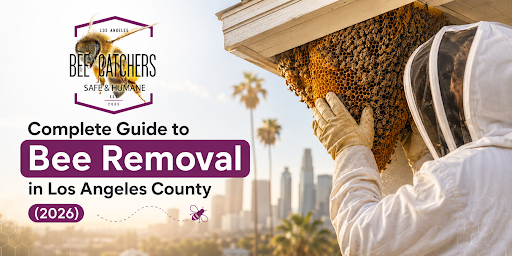
If you’ve found a hive on your property, you’re probably searching for bee removal near me and trying to figure out what to do next — how urgent it is, what it will cost, and whether you should call a pest control company or a bee specialist. This guide covers everything homeowners and business owners across Los Angeles County need to know before making that call.
Why Bees Show Up on LA Properties
Southern California’s climate — mild winters, year-round flowering plants, and plenty of water sources in residential landscaping — makes it ideal territory for honey bee colonies. Bees are drawn to sheltered, dry spaces like:
- Wall voids and attics
- Chimneys and roof eaves
- Sheds, water meter boxes, and irrigation valve covers
- Trees, fences, and outdoor structures
Bee swarm season in Los Angeles typically runs from early spring through summer (March–August), when colonies split and scout for new nesting sites. This is when call volume for honey bee removal peaks across the county.
Step 1: Confirm You Actually Have Bees
Not every buzzing insect is a honey bee. Before calling anyone, it helps to know what you’re dealing with:
- Honey bees — fuzzy, golden-brown, build wax honeycomb, usually calm unless disturbed
- Africanized bees (“killer bees”) — nearly identical in appearance, but far more defensive; common in parts of Southern California
- Wasps and yellow jackets — smoother, more slender, build paper nests rather than wax comb, and are far more aggressive by nature
If you’re unsure, don’t get close. A licensed technician (or even a photo sent ahead of time) can usually identify the species before the visit.
Step 2: Decide Between Bee Removal and Extermination
This is the most important decision in the entire process, and it affects both cost and long-term results. In short:
- Extermination kills the colony but usually leaves the honeycomb behind, which can rot, leak, and attract secondary pests.
- Live bee removal extracts and relocates the entire colony, including full honeycomb removal, and often includes structural repair.
We cover this in full detail in our dedicated guide: Bee Removal vs Bee Extermination: Which One Should You Choose?
For honey bees specifically, live removal is almost always the better long-term choice — both for your property and for local pollinator populations, since honey bees are responsible for pollinating roughly 80% of the world’s food supply.
Step 3: Understand What It Will Cost
Bee removal cost in Los Angeles varies widely depending on hive size, location (a wall cavity costs more than an open tree branch), and whether structural repair is needed. Generally, homeowners can expect anywhere from $150 for a small swarm removal up to $1,500+ for a large, established colony with honeycomb removal and repair work included.
For a full cost breakdown by job type, see our guide: How Much Does Bee Removal Cost in Los Angeles? (2026 Price Guide)
Step 4: Know What a Proper Bee Removal Job Includes
A complete, professional live bee removal service should include:
- Inspection — identifying the species, hive size, and access point
- Extraction — safe removal of bees and the queen using hands-on, non-chemical methods
- Honeycomb removal — removing all wax and honey to prevent future issues like ants, moths, rodents, and fermentation odor
- Relocation — transporting the colony to a sanctuary, apiary, or beekeeper rather than destroying it
- Structural repair — sealing entry points and repairing stucco, drywall, roofing, or siding if needed
- Guarantee — a warranty period in case bees attempt to return to the same spot
At Bee Catchers, this entire process is handled in-house, including structural repairs, and every job comes with a 5-Year Bee Free Guarantee.
Are Bees Dangerous? What You Should Know Before Removal
Most honey bees are not aggressive unless provoked, but Africanized bee removal requires extra caution due to their heightened defensive behavior. Regardless of species, DIY removal is not recommended — disturbing a hive without proper equipment is one of the most common ways people get stung, sometimes seriously. If you or a family member has a bee allergy, treat any active hive as an emergency and keep a safe distance until a licensed technician arrives.
What About Wasps and Yellow Jackets?
While this guide focuses on honey bees, many companies — including ours — also handle wasp removal and yellow jacket removal. Unlike honey bees, wasps and yellow jackets aren’t major pollinators, so extermination is typically the more appropriate method for these pests rather than live relocation.
Areas We Serve in Los Angeles County (and Beyond)
Bee Catchers provides humane bee removal throughout the greater Los Angeles metro area, including cities like Pasadena, Santa Monica, Burbank, Glendale, Long Beach, and Van Nuys, as well as Orange County, Ventura County, San Bernardino County, and Riverside. See our full Locations page to check coverage for your city.
How to Choose the Right Bee Removal Company
When comparing companies, look for:
- State licensing — technicians should be licensed, bonded, and insured
- Live removal, not just extermination — ask directly whether honeycomb is fully removed and bees are relocated
- In-house structural repair — avoids delays and extra contractor costs
- Written guarantees — protects you if bees return
- Experience with Africanized bees — especially important in Southern California
Bee Catchers has over 55 years of combined team experience, an in-house biologist, and has relocated more than 30,000 individual swarms and colonies — all without extermination.
Have bees on your Los Angeles County property? Contact Bee Catchers for a free inspection and written quote, or call 866.544.0074. Explore our full bee and wasp removal services, read more on bee removal cost and removal vs extermination, or browse bee safety facts on our Bee Lore page.
Frequently Asked Questions
How fast can someone come remove a hive?
Most reputable companies, including Bee Catchers, offer 7-day-a-week service and can often respond same-day for urgent situations.
Will removing the hive damage my property?
Not if done properly. Access points are sealed and repaired as part of a complete removal job, which actually prevents further damage from occurring.
What happens to the bees after they’re removed?
With a live removal service, colonies are relocated to sanctuaries, apiaries, or beekeepers — never killed.
Is it worth paying more for live removal instead of extermination?
In most cases, yes. It prevents secondary damage from leftover honeycomb and supports local pollinator populations, often at a similar or even lower long-term cost.