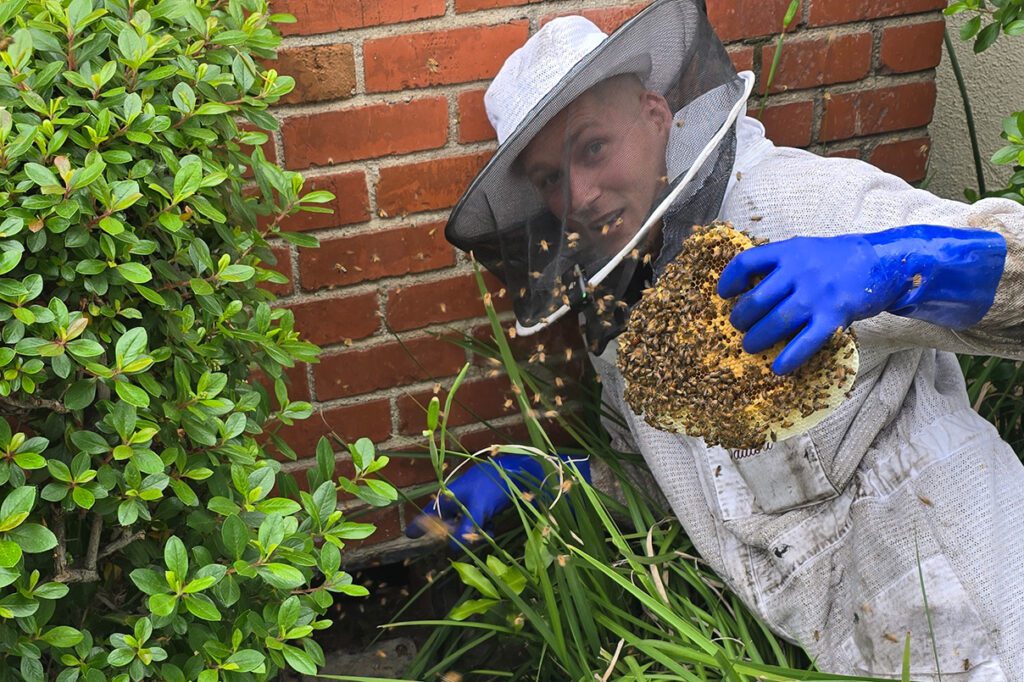
Why Bee Removal Services Are Essential for Homeowners in the USA

Bee Removal Services play an essential role in pollination and maintaining ecological balance, but when they make their homes in or around human dwellings, they can pose serious risks. For homeowners across the USA, especially in regions like California where bee activity is high, professional bee removal services like Bee Catchers, Inc. are not just helpful—they’re essential.

Understanding the Importance of Bees

Before discussing the necessity of bee removal, it’s important to acknowledge that bees are not pests. In fact, honeybees are crucial pollinators that contribute to the success of agriculture and biodiversity. However, when bees establish hives in walls, attics, chimneys, or yards, their presence can create health hazards and structural damage that must be addressed professionally.


1. Health and Safety Risks

One of the top concerns for homeowners is safety. While bees are not typically aggressive, they will defend their hive if they feel threatened.

  • Stings: Bee stings can be painful and, for some individuals, life-threatening due to allergic reactions such as anaphylaxis.
  • Pets at Risk: Curious pets may get too close to a hive and end up getting stung multiple times.
  • Children’s Safety: Kids playing outdoors may unknowingly disturb a hidden hive, leading to dangerous swarming behavior.

By hiring a professional bee removal service like Bee Catchers, Inc., homeowners can ensure the safe and humane removal of bee colonies, minimizing the risk of stings and injury.


2. Structural Damage to Homes

Bees nesting inside walls, roofs, or chimneys can cause extensive structural damage over time.

  • Melting Honeycombs: During hot weather, honeycomb can melt inside the walls, causing honey and wax to seep into insulation and drywall.
  • Attracts Other Pests: The scent of honey attracts ants, rodents, and other insects, creating a secondary infestation.
  • Decay and Mold: Honey and wax buildup can lead to mold growth, moisture issues, and wood rot.

Professional bee removal services not only remove the bees but also the hive and residues, ensuring no long-term damage is left behind.


3. Humane and Eco-Friendly Removal

Bee Catchers, Inc. emphasizes live bee removal—a humane and environmentally responsible alternative to extermination.

  • Save the Bees: Bees are already in decline due to habitat loss, pesticides, and disease. Live removal protects these valuable pollinators.
  • Rehoming Colonies: Professional removers relocate bees to safe, managed environments where they can continue to thrive.
  • Avoid Chemical Exposure: Unlike exterminators who may use harmful pesticides, bee removal professionals avoid toxic chemicals that can be dangerous to humans and pets.

Homeowners can feel good about choosing a service that prioritizes bee conservation while also protecting their property.


4. Legal and Ethical Considerations

In several U.S. states, including California, bees—especially honeybees—are protected by law. Improper removal, extermination, or destruction of colonies may lead to fines or penalties.

  • Local Regulations: Certain municipalities require permits or documentation before removing hives.
  • Protected Species: Some bee species fall under protection laws, making professional removal not just ideal, but legally necessary.
  • Neighborhood Safety: DIY methods can pose risks to neighbors and the surrounding environment.

Using certified professionals like Bee Catchers, Inc. ensures full compliance with state and local regulations, eliminating the risk of legal issues.


5. Emergency Bee Removal

Bees can sometimes appear suddenly in large swarms, particularly during spring and early summer.

  • Swarm Behavior: While swarming bees are typically non-aggressive, the sudden presence of thousands of buzzing bees can be frightening.
  • Blocked Entrances: Bees entering through vents or chimneys may block airflow or even enter living spaces.
  • Immediate Danger: In rare cases, Africanized “killer” bees may pose a genuine threat to humans and animals.

Bee Catchers, Inc. offers emergency bee removal across Southern California, providing fast, safe, and effective solutions for urgent situations.


6. Expert Knowledge and Equipment

Professional bee removal requires more than a can of spray and a ladder. It involves understanding bee behavior, hive structures, and safe handling techniques.

  • Thermal Imaging: Experts can locate hives hidden deep within walls using specialized equipment.
  • Protective Gear: Full suits and smoke tools ensure safety during the extraction process.
  • Hive Removal and Cleanup: Professionals remove the entire hive and disinfect the area to prevent re-infestation.

This level of technical expertise is not something the average homeowner possesses—making professional services critical for effective results.


7. Long-Term Prevention

A key benefit of professional removal is the added step of prevention.

  • Hive Residue Cleanup: Leftover honeycomb can attract new swarms if not removed completely.
  • Seal Entry Points: Bee Catchers, Inc. helps homeowners identify and seal cracks, vents, and other access points.
  • Advice on Landscaping: Some plants and nesting materials attract bees—experts can recommend bee-safe landscaping practices.

Preventing future infestations saves money and stress in the long run, giving homeowners peace of mind.


8. Cost-Effective and Insurance-Friendly

Many homeowners are tempted to try DIY methods, thinking it’s a cheaper solution—but it often backfires.

  • DIY Failures: Ineffective removal can lead to repeat infestations or bigger damage over time.
  • Hidden Costs: Wall repairs, pest control, and medical bills from stings can quickly add up.
  • Insurance Claims: Some insurance providers require proof of professional removal to cover bee-related damages.

Professional bee removal is a smart financial decision, and Bee Catchers, Inc. provides affordable and competitive pricing for all types of infestations.


9. Region-Specific Challenges

Different regions in the USA face different bee challenges. In Southern California:

  • Warm Climate: Year-round warm temperatures support longer bee activity.
  • Urban/Suburban Spread: Bees increasingly build hives in urban areas due to habitat loss.
  • Africanized Bees: Known for their aggressive behavior, these bees are common in parts of the Southwest.

Bee Catchers, Inc. is locally experienced and understands the specific needs of Southern California homeowners, offering tailored solutions for each situation.


Conclusion: Trust Bee Catchers, Inc. for Safe and Responsible Bee Removal

Bee infestations are not just a nuisance—they’re a serious matter requiring expert attention. Whether it’s protecting your family, your home, or the bees themselves, professional bee removal services are an essential part of responsible homeownership in the USA.

At Bee Catchers, Inc., we pride ourselves on being Southern California’s trusted partner in humane, eco-friendly, and effective bee removal. Our trained specialists are ready to respond quickly and safely to any situation, ensuring peace of mind for homeowners while doing our part to protect the planet.

Contact Bee Catchers, Inc. today for a free consultation or emergency bee removal service. Let’s keep your home safe—while saving the bees.

Get Rid of Bees the Right Way

[et_pb_section fb_built=”1″ _builder_version=”3.22″][et_pb_row _builder_version=”3.22″][et_pb_column type=”4_4″ _builder_version=”3.22″][et_pb_text _builder_version=”3.22″]

We understand bees can be scary creatures but it’s important to be sure to get rid of them the correct way because of their importance to the environment.

Click here to listen to Nicole on KFI AM 640 Home with Dean Sharp

[/et_pb_text][/et_pb_column][/et_pb_row][/et_pb_section]

Amazing Honeybees

Palos Verdes Peninsula Land Conservancy
White Point Nature Preserve
1600 W. Paseo del Mar, San Pedro, CA 90731  on the north side of Paseo del Mar off of Western Avenue. The contact number for the Center is 310-561-0917.
A presentation on the importance of the honeybee and the vital role they play in our ecological and agricultural environments.
A beautiful place in San Pedro, California with breathtaking views, and so much to learn and enjoy.

Wild for the planet at the LA ZOO – 2017

At the LA Zoo, this year’s event promises to be more festive than ever as we mark our 50th Anniversary. Running from Earth Day (April 22) through Endangered Species Day (May 19), we’re putting a spotlight on conservation every day for a whole month. Weekends are even more special, with fun, informative activities, shows, and presentations that will inspire as well as entertain.

For more info please visit the links below:

http://www.lazoo.org/wildfortheplanet/

http://www.laparent.com/events/wild-planet-los-angeles-zoo/


UCLA Volunteer Day 2016

On Volunteer Day 2016, Bruins will perform service at over 50 sites across Greater Los Angeles. Sites will include schools, parks, shelters, hospitals, veterans’ sites, community gardens, food banks, and many other community locations.
This year, first year freshmen and transfer students joined together with continuing undergraduates, graduate students, faculty, staff, alumni, parents, and community members to visit sites across greater Los Angeles. Click here http://volunteerday.ucla.edu/2016-sites/?id=10 to see the project that Bee Catchers, Inc., is leading this year. We are very excited to be a part of something so exciting and impactful. If you are interested in volunteering, visit http://volunteerday.ucla.edu for more information.  If our site is full for volunteers and task captains, there are many more projects to choose from.

Are Those Bees Or Yellow Jackets That Are Residing In Your Walls?

Do You Have Bees or a Yellow Jacket Hive In Your Walls or Attic?

Is That Buzzing You Hear in Your Walls a Sign That Bees Or Yellow Jackets Have Invaded?

Bee Catchers Southern California

Have bees taken up residence in the walls or attic of your house or business location? The incessant humming you hear might be a signal to take action. Depending on whether it requires getting rid of bees, yellow jacket eradication, or another pest or problem not yet determined. Before you do anything definitive, it would be smart to decide precisely what. If anything, is in fact sharing your space.</p>

First, of course, you have to be mindful of the target. Do you hear buzzing almost continually in a particular location or do you suspect an invasion. Because you see a bee flying aimlessly throughout the room?. If it’s just one bee flying into windows, it probably just lost its way and got into your abode by accident.</p&gt;</p>

&lt;p>However, if you see a single or several bees moving back and forth from a specific spot. The chances are you have a hive that needs to be addressed. The first course of action is to just watch it quietly and locate the gap through which it enters and exits. Since these spaces can be minuscule, a flashlight is a big help in finding the exact spot. Conversely, it is possible that you never see any critters flying about your space, but you do hear that tell tale humming that seems to be coming from the walls. Once the precise location is determined, do not start poking around; there’s a reason the phrase “don’t disturb a hornet’s nest” is a cliche. Getting rid of bees is always best left to professionals.

When pinpointing which insect you’re harboring, you can start by checking the season. Generally speaking, if it is fall or winter, you probably have honey bees since yellow jackets seldom spend the colder months inside walls in most regions of the country. An in depth look at the visitor is also in order. Honey bees are about 2/3 inch long, are covered with hairs and have a form of basket on their back legs in which they collect yellow or dark green balls of pollen. They vary in color from yellow to black and have black or brown stripes across the abdomen.

Yellow jackets, however, don’t have the same thick hairs or the pollen baskets. They are somewhat smaller than honey bees and sport alternating stripes of yellow and black. If they build a nest in your residence, it will be invisible and the only clue you will have is to see them flying into cracks or crevices from the outside of the house. The ground bee is a variety of yellow jacket that creates nests in holes in the ground. They are often painfully hostile if disturbed by oblivious pedestrians or lawn mowers.

&lt;p>No one wants to share living quarters with stinging insects, so whether you’ve been invaded by bees or yellow jackets, there are experts one can call. Removal requires far more than “killing” the offending creatures. Eco-friendly bee removers will take care to remove the complete hive. Repair any damage the invaders may have caused, and in the case of honey bees, find a bee keeper to take in the hive. Thus doing their part to sustain this essential species. Calling an eco-responsible bee catcher is the recommended solution to rid your home of annoying, potentially painful, possibly lethal insects.

JAPANESE GIANT HORNETS

In the last article we wrote about Honeybees and how extremely crucial they are too
human and plant survival. Included in the article was a brief description of what an active
Honeybee hive consists of. For those who have not read the last article. Refer to……

Why Honeybees are so important and should not face extermination.
Offered is a recap, and short commentary explaining how an active, thriving Honeybee: hive
with 30.000 to 80,000 bees, survives and the responsibilities of the different bees within the hive.
1) There is only one Queen Bee in a hive. Responsibility; to lay up to 2000 eggs per day.
2) Worker bees are the most abundant in the hive. All are non-reproductive females. Duties, act
as nurses, builders, protectors, and nectar and pollen gatherers for the hive.
3) Drones are all males, less in numbers then workers. Only duty is to mate with the Queen Bee.
Note: Only Queen Bee and worker bees have stingers. Worker bees die after one sting. Queen
Bee can sting over an over without dying.

In the previous piece, we tried to make the public aware of how important it was to save
honeybees. Unfortunately, an unknown cause is decimating the honeybee population. Civilian
and Military Scientist are working feverishly to find the source, but unfortunately they have not
been successful. The good news is that they might be on to something. Lets all hope for the best.

Since the Honeybee was introduced to the United States from Europe, there are many
natural enemies of the honeybee, just to mention a few, parasites, mites, birds, frogs, wasps,
hornets, and bears, which love honey and destroy thousands of wild bee hives in wooded areas.
God knows that the honeybee does not need more enemies, especially man made or imported.

However, one enemy of the Honeybee does not reside in the United States. It resides in
Eastern Asia. Specifically in Japan, Korea, Taiwan, Indochina. China. India.

It is the Asian giant hornet, or a subspecies known as THE JAPENESE GIANT HORNET!!!,
that has captured our interest.  It is the largest and the most fearsome hornet in the world. It is approximately 2 inches in  length, with a stinger approximately ¼ inch long. Its head and eyes are large and orange in color
with a banded brown and yellow abdomen. It uses its large mandibles, rather then its stinger to
crush its prey.  The reason why there is interest in this hornet is that the Japanese have a native
honeybee, but that specie does not produce the volume of honey that European honeybees
do. Therefore, the Japanese have imported European honeybees. Unfortunately the European
honeybee has very little or no defense against the Japanese giant hornet.
The native specie of honeybees unlike the European kind, have over time developed an
effective defense to combat these giant hornets. When a solo giant hornet lands on its nest, the
native honeybee forms a large ball and engulfs the hornet, causing its temperature to rise and in
turn kill it, thus not allowing it to leave a scent for others giant hornets to follow.
The European honeybee has no such defense. When a single giant hornet ( or scout) finds
a European honeybee hive, it secretes a pheromone that attracts other hornets. Once the giant
hornets discover a nest, a large number of them attack the beehive.

In a matter of hours, 30 giant  hornets can kill a honeybee hive of 30,000. Once a nest (or hive) is decimated, the giant hornets  remove the honeybee larvae and dead bees and return to their hive to feed them to their young.
As we first stated in this article, the Japanese Giant Hornets resides in Eastern Asia’s
warm and humid tropical areas but just as so many non-native species of plants, insects, and
animals have found their way into the United States and unfortunately survived. We certainly do
not need another enemy of the European honeybee. Let us keep hoping that this monster insect
remains in Eastern Asia.

Bee Catchers will continue to save bees. If you have questions about bees and before
you think of exterminating a beehive, remember how important they are to your survival, please
Call Bee Catchers at 866-544-0074 or visit our web site at www.BeeCatchersSoCal.com

Bee Happy!

Reasons why honeybees are so important & should not be exterminated!

Honeybees are one if not the most important insects alive. They are responsible for pollinating 80% of our fruits, vegetables, nuts, plants, grains, and most of the vegetation that grows in our forests and fields. Honeybees are most important when it comes to pollinating trees.

Without Honeybees two-thirds of our citrus, nuts and some fruits would disappear in the coming years. Some scientist’s believe that the reduction of the Honeybee population is as serious a problem as global warming.

Someone said, (but not verified) that the late Albert Einstein once remarked that, “If all the Honeybees disappear through-out the world, mankind would exist for approximately four years.” It is so important that we do all we can to save the Honeybees, because a great number of Honeybees and their hives are dying at a rapid pace.

The Honeybee population has shrunk from approximately 5.9 million to approximately 2.4 million in the last 50+ years. Since 2006, 20/40% of the hives have suffered “colony collapse.” The problem is so dire in California that local beekeepers are looking to import Honeybees from other states and foreign countries. The sad fact is that scientists have yet to discover the cause for the Honeybees rapid decline.

A SHORT HISTORY ABOUT THE HONEYBEE

The Europeans introduced the Honeybee, to the United States, during the colonial period because of their ability to create large hives, pollinate crops, and produce large quantities of honey. The great Aristotle referred to honey, as nectar from the Gods. An active hive consists of a Queen, and anywhere from 40,000 to 80,000 worker bees and drones. There is only one Queen in the hive at any given time. Her responsibility is to lay approximately 2,000 eggs per-day. The largest number of bees in a hive is worker bees. They are all females and lack reproductive capabilities. At the early stage of their lives, they act as nurses, builders, and protectors of the hive. After they mature, their duty is to scout and retrieve nectar and pollen. The Queen and the worker bees are the only ones who have stingers. Worker bees only die when they sting humans because they have a barb on the end of their stinger that will not allow it to retract it from the thickness of human skin. Queens can sting repeatedly because their stinger does not have a barb and is therefore smooth. Drones are males and their only function is to mate with the Queen. There are far fewer drones then worker bees in a hive.

Think carefully before you consider exterminating the Honeybees on your property.

BEE CATCHERS is a state licensed, family owned company, with more than fifteen years of experience, committed to saving, and relocating Honeybees, so that we can all continue to enjoy the fruits of their labor.

At Bee Catchers we give all of our bees away to people and organizations that can use them.  They are saved, rescued and relocated! They are given to backward beekeepers, hobbyists, farmers, orchards and apiaries!

Why Hire Professionals To Remove Bees From Your Home Or Business?

If you have found that you have an active beehive on or near your home or business, your first instinct may be to simply grab a can of bug killer and start spraying away, or perhaps to call an exterminator. There are, however several reasons why that is the last thing on earth that you should do. The most obvious reason for this is that you probably don’t have the right equipment or know-how to safely, properly and permanently dispose of or remove a beehive without getting yourself stung and doing more harm than good. Here are some other reasons that, when you need some help getting rid of bees, you should call in the experts to have them removed.

1. Bees should not be killed. Simply put, there is no overstating the importance of these creatures to the sustenance of life on earth. Yes, you read that right. Bees do the vast majority of the work of pollinating the crops that grow the plants that feed all of us, and that feed the animals we raise as well. Due to many factors, including pesticides, the number of bees and active beehives is already decreasing at an uncomfortable rate. So, if at all possible, these valuable creatures should be safely removed from your property by hiring a qualified bee removal service. The best of these services practice eco-friendly bee removal, and have deals with professional beekeepers to move the entire colony to a farm where these creatures can continue to do their valuable work.

2. Hives Need To Be Removed Completely. Beehives are, naturally, full of honey, and if they are not removed completely from your premises along with the bees, they will attract other pests such as ants, wasps, flies, and vermin. There is also a much greater chance that bees that are not captured, or a neighboring colony, will attempt to re-colonize the hive if it is not properly and professionally removed.

3. Hives Can Leave Structural Damage. And the best bee removal experts will repair this damage as part of their services.

4. Removal is Pesticide-Free. So it doesn’t leave any toxic or poisonous residue behind. Bees are removed in perfect health, and are relocated to a place where they can happily go about their business without disturbing yours. And, of course, no poisonous fumes seep into your home or business potentially compromising the health of all residents and workers.

So if you are having trouble with a beehive, do the right thing and call in the experts to have them removed safely and in an eco-friendly manner.

Bee Happy it’s Friday!!!!